
Disinformation narratives crossing borders, images taken out of context, hoaxes targeting the victims of war. Facing the constant wave of disinformation triggered by a war that has left thousands dead and injured is more effective when there is collaboration with the community and with other organizations. On February 24, one year marked since the start of the Russian invasion of Ukraine, and at Maldita.es we have confirmed that coordination and cooperation are the most effective approach to tackling global disinformation.
You can listen to our special podcast “One year of the invasion of Ukraine and its hoaxes” on Ivoox, Spotify and Apple Podcasts
A full team working to debunk more than 170 hoaxes about the war in Ukraine
Just minutes after Russian president Vladimir Putin officially announced the start of the attack on Ukraine, a flood of shocking images began circulating on social media, moving from chat to chat, and even appearing on television. Some were real… and others were hoaxes.
In the early days of the war it was common to find videos from past conflicts, recorded in other countries, or even footage from video games. That is why the Maldita.es team began debunking hoaxes intensively, especially during the first weeks, before the disinformation evolved into more sophisticated formats, as we have explained in our analysis of how the hoaxes changed over time.
Between the content you sent us through our WhatsApp chatbot (+34 644 22 93 19) and what we detected ourselves, in one year we debunked more than 170 hoaxes about the war in Ukraine, which we have compiled to better understand how they work.
#UkraineFacts: a collaborative database among international fact-checkers to confront a global disinformation campaign
All these lies, half-truths and baseless claims have circulated worldwide since February 24, 2022, and many of them were exactly the same but in different languages. The idea that this wave of disinformation was also appearing in other countries led Maldita.es to create a database and give access to more than 100 fact-checkers in 88 countries, so they could collaborate, avoid duplicating efforts and analyze the phenomenon from a global perspective.
Since then, #UkraineFacts has recorded more than 2,800 fact-checks and has generated more than 150 national and international mentions as a reference source. This open tool includes a map that allows users to access fact-checks of the most viral hoaxes. In #UkraineFacts you can see in which countries each piece of disinformation has been detected and access the fact-checks published by the different verification organizations that investigated it.
Equipo O: boosting investigations with open sources and the OSINT community
In a war taking place thousands of kilometers away but told in real time on social media, it was essential to geolocate images, verify dates, or identify the weapons used in attacks on civilians. For that reason, Maldita.es created “Equipo O” — O for OSINT, open-source investigation — a volunteer anti-hoax brigade working together to fight disinformation about the Russian invasion of Ukraine.
Thanks to this team, formed by members of our community who shared their superpowers related to OSINT and the Russian and Ukrainian languages, we were able to carry out several investigations whose results contributed to accountability in the war, including work on the Bucha massacre, the explosion at the Mariupol theatre, and the missile attack that killed civilians near the Kramatorsk train station.
Analyzing disinformation formats and the channels that spread them
Identifying the formats used in disinformation was one of the first tasks taken on by the Maldito Bulo and Maldita Educa teams. From subtitles that did not match the audio, to magazine covers that never existed, fake fact-checks, false-flag narratives, or accusations that Ukrainian president Volodymyr Zelensky was a Nazi or a drug user. All these formats were compiled to create a catalogue that helps raise alerts when facing new disinformation.
Tracking the channels that tend to spread disinformation also allowed us to conclude that some groups that previously spread COVID-19 denialism shifted to denying Russian attacks and promoting pro-Putin narratives. Telegram was one of the main platforms where these groups were identified, leading to an investigation analyzing more than half a million messages from 39 channels with over 5,000 subscribers each.
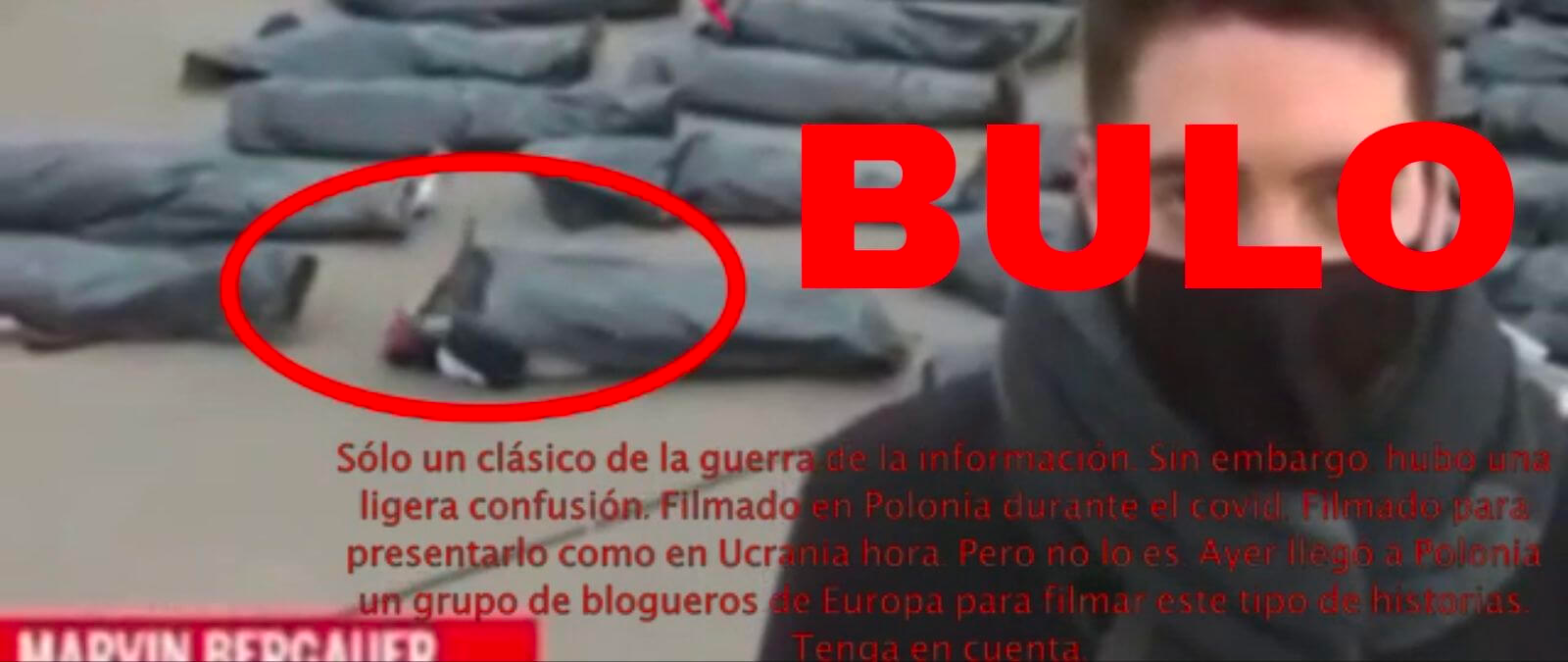
Precisely these groups were dedicated to making hoaxes go viral in Spanish that had previously spread in other languages, the same phenomenon identified through the global database of fact-checks about the war in Ukraine. A curious fact? The hoax that was debunked the most times worldwide, according to an analysis of the #UkraineFacts database, was based on images supposedly taken in Ukraine that allegedly showed victims of Russian attacks moving inside body bags, but which in reality came from a climate protest in Austria. That same hoax reached 120,000 views on the channel of Rafapal, a well-known Spanish disinformation spreader analyzed in the Maldita.es investigation “The Telegram denialists.”
Sharing what we learn
As we learned and gathered experience, it became necessary to share the knowledge we had gained. At Maldita.es we use a range of tools to fight disinformation, and in different talks, workshops and forums we usually explain how we use them so that you can also verify information on your own. Some of these tools include InVid, Google Images reverse search and Wayback Machine, but we have also used geolocation tools such as Google Earth and even Wolfram Alpha Weather to determine whether a piece of information is accurate. In addition to offering our toolbox, Maldita Educa explains how to use each of these tools with practical examples.
But not only there; if you regularly follow our daily Twitch streams, you may remember a special session with resources to help you avoid being misled by hoaxes about the Russian invasion of Ukraine. And you probably already know this, but we are also very active on TikTok. Disinformation about the invasion is present there too, as a NewsGuard study warned, showing how the platform can display this kind of content to new users within minutes.
That is why, in the middle of a wave of lies, half-truths and out-of-context viral posts, the team got to work sharing fact-checks when we passed 100 debunked hoaxes, as well as in five compilations [which you can see here: 1, 2, 3, 4 and 5]. Remember: in crisis situations, do not share anything unless you are sure it is true, and send us anything suspicious at +34 644 229 319.
A network of collaboration to study and fight disinformation
Alongside this work, cooperation between organizations also grew. The European Fact-Checking Standards Network (EFCSN) and its Code of Professional Standards were created in this context. Collaboration increased with fact-checking organizations in Central and Eastern Europe, including Ukraine, to strengthen technical capacity and training in the fight against disinformation.
Maldita.es also took part in the European Digital Media Observatory (EDMO) working group on disinformation and the war in Ukraine, sharing daily observations, trends and recommendations, which contributed to a final report published online.
During the crisis, platforms relied on content produced by Maldita.es for dashboards and third-party fact-checking programs. Better access to platform data remains necessary to fully understand the threat. We also contributed to the crisis response subgroup of the Code of Practice on Disinformation, sharing information with the European Commission, ERGA and other signatories, including major online platforms, civil society organizations and researchers.