
Understanding the digital channels through which information is consumed in Spain, the level of trust (and distrust) audiences place in them, and having an approximate sense of concern about disinformation is very useful in the fight against it. These data are among the ten key takeaways from the new annual report on digital news consumption published by the Reuters Institute for the Study of Journalism in 2024.
This 13th edition, in a year marked by electoral processes around the world and in the context of the wars in Ukraine and Gaza, is based on an online survey conducted between late January and early February 2024 by YouGov, with 95,000 interviews in 47 countries across five continents. In addition to platform and format consumption trends—such as video—that can be consulted in the general report, below we summarize ten key findings from the data for Spain analyzed by the University of Navarra on disinformation and content consumption.
1. WhatsApp, the main source of online news consumption in Spain
One of the main new findings of the Digital News Report in Spain is that WhatsApp has become the leading digital platform. It remains the most widely used platform (75% of Spaniards use it regularly), but this year it is also the most used for staying informed. Twenty-seven percent of respondents get news via WhatsApp, surpassing Facebook for the first time, which is used by 26% of the population for news.
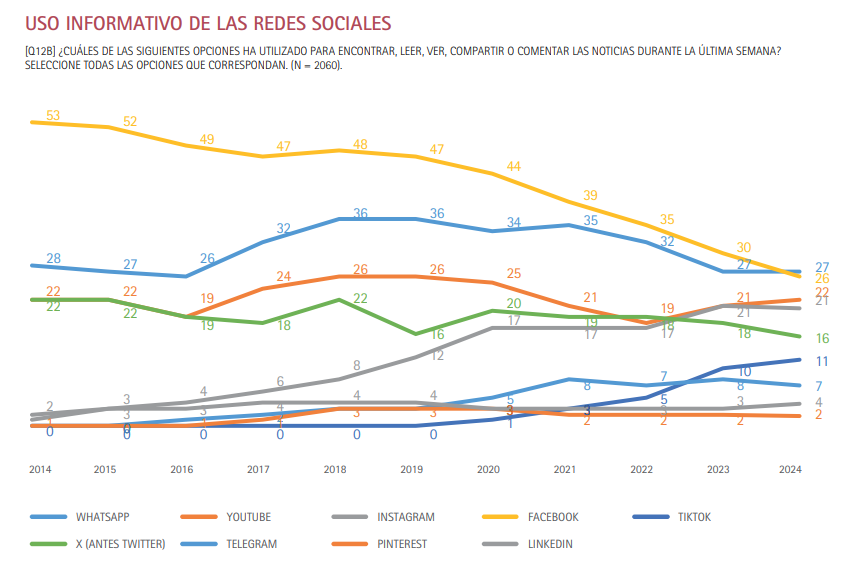
Screenshot of the Digital News Report Spain chart by the University of Navarra.
The importance of WhatsApp in Spain is made clear in the following chart, which compares usage percentages in Spain with the global average.

Screenshot of the Digital News Report Spain chart by the University of Navarra.
2. Growing concern about disinformation
Concern about online disinformation in Spain has increased by six points compared to the previous year. Seventy percent of citizens say they are worried about knowing what is true and what is false in digital environments.

Screenshot of the Digital News Report Spain chart by the University of Navarra.
At a global level, Spain is 11 points above the average. Among European countries, it is grouped with those showing the highest levels of concern, alongside Portugal, Ireland, and the United Kingdom.

Screenshot of the Digital News Report Spain chart by the University of Navarra.
Age is an important factor in this concern. Older people tend to worry more about disinformation. However, even among young people, the level of concern is high. Almost two thirds of those aged 18 to 24 acknowledge that they are worried about knowing what is true and what is not online.
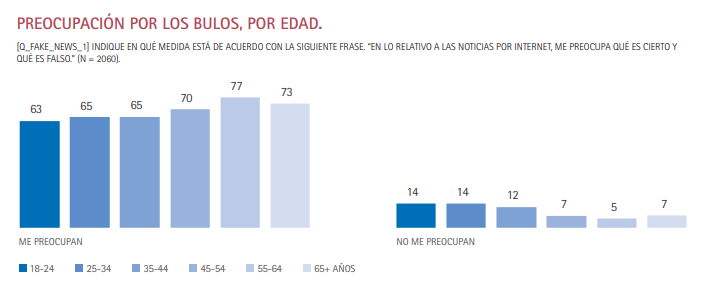
Screenshot of the Digital News Report Spain chart by the University of Navarra.
3. Politics is the main topic in which hoaxes are detected
Thirty-seven percent of respondents say they have detected false or incorrect content about politics. It is the main topic for misinformation, followed by coronavirus, the economy, and immigration. However, when comparing these data with those from 2022, misinformation about politics has fallen by six points and coronavirus-related misinformation by 23 points, while misinformation related to the economy has risen by eight points and that related to immigration by three points.
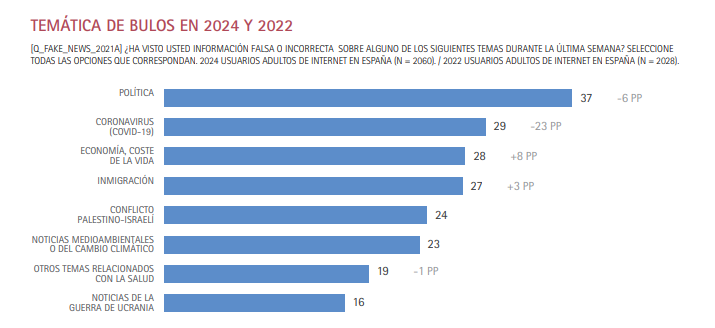
Screenshot of the Digital News Report Spain chart by the University of Navarra.
4. News avoidance among Spaniards is increasing
Thirty-seven percent of Spaniards say they try to avoid the news (12% say they do so often and 25% sometimes). This represents an increase of nine points compared to last year.
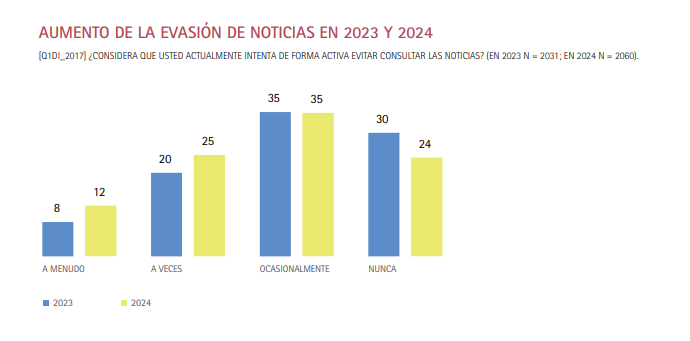
Screenshot of the Digital News Report Spain chart by the University of Navarra.
Here too, a generational gap is evident. Among those under 35, 44% avoid the news. People older than that are less likely to reject news, with 35% saying they avoid it.

Screenshot of the Digital News Report Spain chart by the University of Navarra.
5. Spaniards’ trust in the news remains low
Thirty-nine percent distrust the news, compared to 33% who do trust it. These figures are similar to those of the previous year and maintain a situation that began in 2022: there are more people who distrust the news than those who trust it.
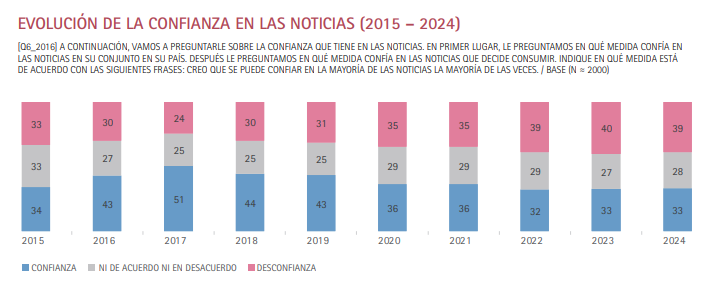
Screenshot of the Digital News Report Spain chart by the University of Navarra.
This trust is closely related to age. Young people are particularly skeptical, and trust in the news increases with age.
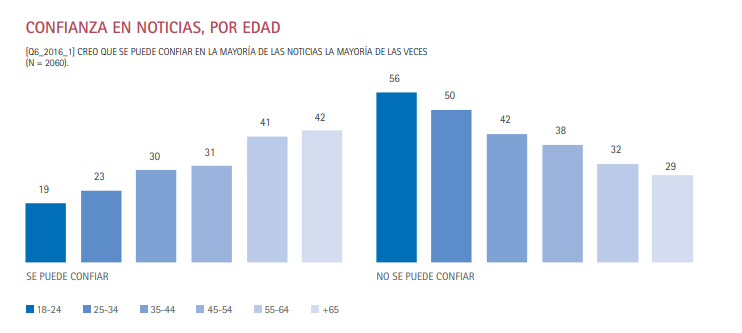
Screenshot of the Digital News Report Spain chart by the University of Navarra.
6. Google and WhatsApp: the platforms Spaniards trust the most
The digital platform that generates the most trust among Spaniards is Google, considered reliable by 55% of the population. WhatsApp appears in second place with 53%. The least trusted platforms are X and LinkedIn, with 37%.

Screenshot of the Digital News Report Spain chart by the University of Navarra.
Once again, breaking down the data by age reveals notable differences. For example, people over 65 have very low trust in TikTok, while among young people trust levels remain much more stable across all social networks.

Screenshot of the Digital News Report Spain chart by the University of Navarra
7. Young people get news on Instagram and X; older people on Facebook and WhatsApp
When it comes to staying informed, young and older people turn to different networks. Those under 35 mainly get their news on Instagram (29%) and X (28%), while those over 35 rely much more on Facebook (30%) and WhatsApp (29%). On TikTok, it is young people who seek out information, while the percentage of those over 35 who do so is small—just 8%.
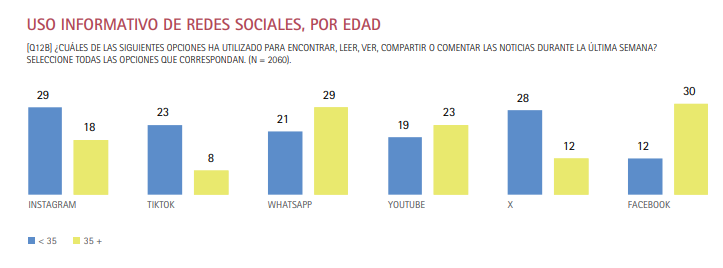
Screenshot of the Digital News Report Spain chart by the University of Navarra.
8. TikTok users trust ordinary people; X users trust the media
On social networks, not all messages are trusted equally. The source of the content received is important in evaluating it, and on each platform users tend to trust different sources more. For example, on TikTok there is a high level of trust in ordinary people. Users of X also trust ordinary people a great deal, but trust conventional media even more. Instagram is the social network where celebrities—both from the entertainment world and influencers and content creators—are trusted the most.
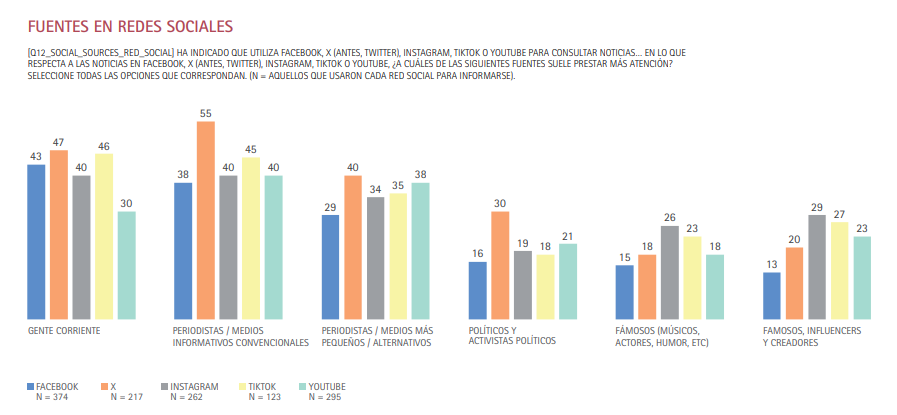
Screenshot of the Digital News Report Spain chart by the University of Navarra.
9. Social networks are the main gateway to digital news
Social networks are the main entry point to digital news for 28% of respondents. This percentage almost doubles that of people who go directly to news websites or apps (15%).

Screenshot of the Digital News Report Spain chart by the University of Navarra.
This behavior also varies by age. Younger groups are more likely to access news through social networks. For example, 40% of respondents aged 25 to 34 do so this way, compared to 21% among those aged 55 to 64.
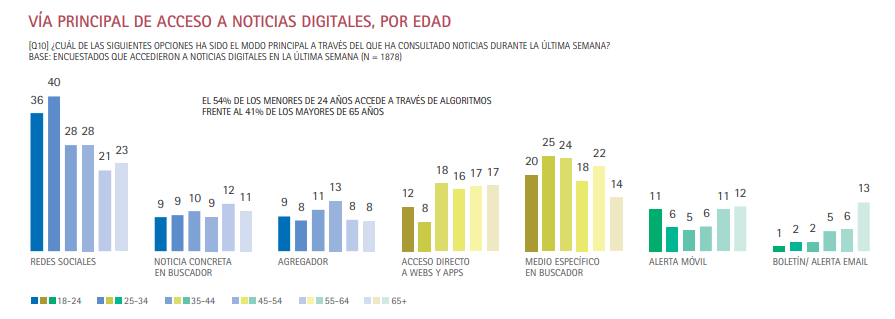
Screenshot of the Digital News Report Spain chart by the University of Navarra.
10. Spain leads Europe in sharing news via instant messaging
The most common way Spaniards engage with the news is by talking about it face to face with friends. Thirty-nine percent of the population do so, nine points above the global average. Spain also clearly differs from the international average in how news is shared. Spaniards mainly use messaging apps (WhatsApp and Telegram) to share news content. Thirty percent do so, compared to a global average of 21%.
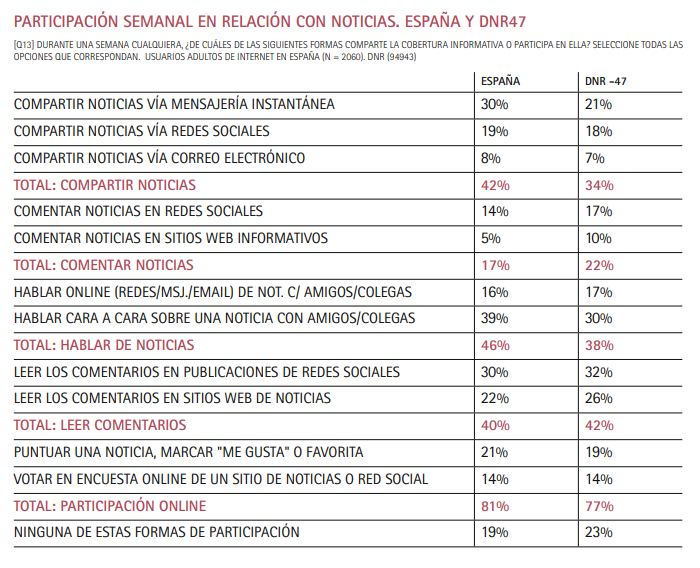
Screenshot of the Digital News Report Spain chart by the University of Navarra.