
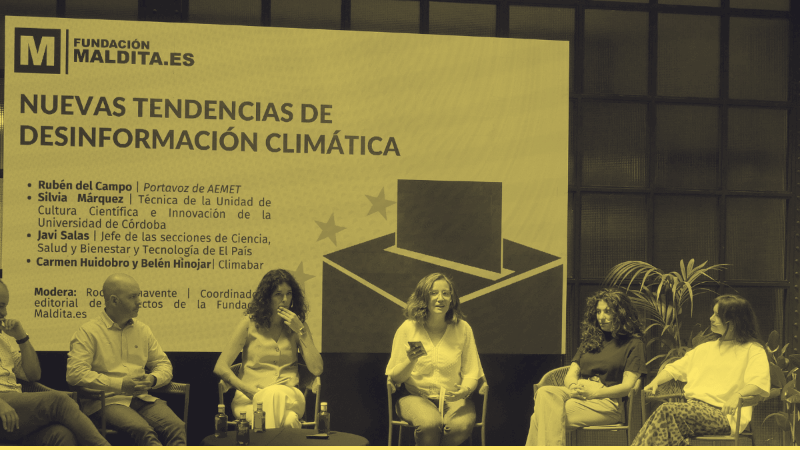
The event featured Carmen Huidobro and Belén Hinojar (Climabar), Rubén del Campo (spokesperson for AEMET), Silvia Márquez (technician at the Scientific Culture and Innovation Unit of the University of Córdoba) and Javi Salas (head of the Science, Health and Wellbeing and Technology sections at El País). The panel was moderated by Rocío Benavente, editorial project coordinator at the Maldita.es Foundation, and was part of the conference “Disinformation, Media and the Future of the EU” held on 27 May at the Larra Journalism Lab in Madrid.
“On social media it has got worse; the more we know about the climate crisis, the less seems to be understood. But we also have hope because we are seeing coalitions and tools emerging to curb disinformation on social media,” said Huidobro.
Salas noted that “when we talk about climate, we are talking about identities, about politics,” and highlighted how disinformation has shifted directly from COVID-19 to the climate emergency. “A sense of unease and anger has crystallised, linking many things: nostalgia, identity, what they want to do to me. There are many different narratives intersecting.”
Márquez agreed with the other speakers that the problem of climate disinformation is worsening. “But I am optimistic, and I see that from scientific culture units there is concern, both in terms of projects and funding, about tackling this disinformation and providing citizens with tools to address it. Researchers also believe more strongly in their role in confronting disinformation,” she added.
“Unfortunately, we have an ally against disinformation, which is the climate itself. There is already a perception among the public that it has changed,” said del Campo. “The debate still exists, there is much more noise and it is getting worse, but perhaps the debate is moving away from the scientific sphere and into another one, focused on what actions should be taken and how we should adapt.”
During the event, the results of the Clima Informa project were presented. The project identified the main climate disinformation narratives in the context of the European elections and established a partnership with seven media outlets: 20 minutos, cadenaser.com, elDiario.es, La Marea, La Vanguardia, Servimedia y Onda Cero Castilla-La Mancha.