
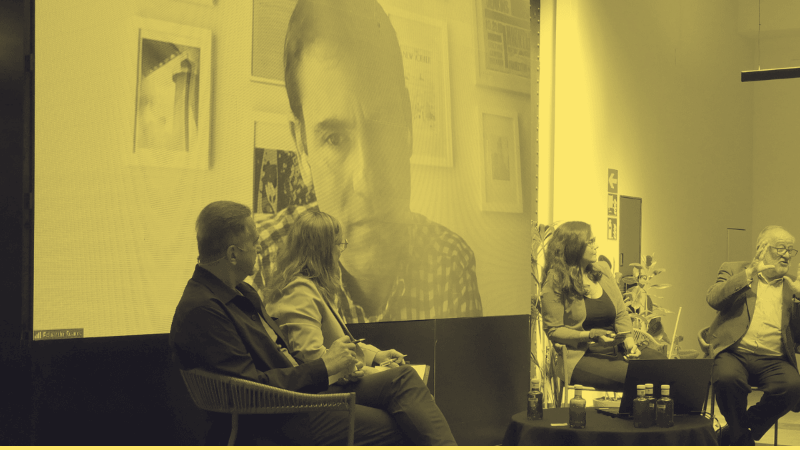
The discussion was moderated by Clara Jiménez Cruz, President of the Maldita.es Foundation, who raised several aspects she considers necessary in order to say that something is a media outlet: “financial transparency, transparency in editorial leadership, and finally, how that outlet corrects errors—how transparent it is.”
According to Jiménez, it is necessary to define what a media outlet is “so that institutional and private advertising does not fund disinformation” and in order to “protect media outlets and freedom of expression from what are not media outlets.” “In a place where there are no anchors to hold on to, it is very difficult to distinguish a legitimate news brand from one that is built to publish disinformation,” she added.
Participants in the debate included Eduardo Suárez, Head of Content at the Reuters Institute for the Study of Journalism; Fernando González Urbaneja, President of the Arbitration, Complaints and Ethics Commission of the Federation of Associations of Journalists of Spain (FAPE); José Miguel Contreras, Director of Content at Prisa; and journalist Carmela Ríos.
Regarding what constitutes a media outlet, Suárez said that “the President of the Spanish Government has sparked a debate in a crude way, and it is harmful to press freedom and freedom of expression to make generalized accusations against all digital media. We are in an era in which all media are digital.”
As for media regulation, Suárez distinguished between public media, where he believes that “there is still a great deal to be done because in Spain they have always been highly partisan and heavily controlled by the government in power, and that is a serious problem,” and “regulated media, such as private television,” for which he cited the lack of a regulator like the UK’s Ofcom, “which ensures that television channels are impartial, issues rulings and imposes sanctions—a regulator with well-designed governance.” Regarding private media, Suárez argued that “the answer is probably self-regulation, trying to ensure that as many media outlets as possible have standards,” citing the International Fact-Checking Network’s code as an example. “It would not be too difficult to create a similar code for media outlets.”
Contreras expressed support for the existence of regulation for media outlets. “It is clear that the self-regulation mechanisms we have put in place have failed, and therefore at some point rules will have to be introduced. They do not have to be definitive—this is a very complex issue, and I am in favor of proceeding step by step.” The Director of Content at Prisa defended the need to discuss the issue: “If there is no debate, the issue disappears, and we live in this kind of strange mystery of self-regulation—of the idea that it already works on its own and that simply opening one’s mouth is an attack on freedom of expression. And it is clear that this does not work.”
“The problem with journalism today is reputation and credibility. If we do not refocus on credibility, we will continue lurching from bad to worse,” said Urbaneja, who supports “including the requirement to comply with the code of ethics in journalists’ employment contracts.” “Journalism manages the reputation system of individuals and institutions; therefore, transparency and incompatibilities must be required—you cannot be an editor and seven other things at the same time,” he stated. Urbaneja believes that the debate over what constitutes a media outlet will not end, but that progress will be made in levels of awareness.
For Ríos, “part of the evolution of this debate about media will be linked to the evolution of the relationship that citizens and public opinion have with the truth.” “I believe there is a personal and civic reflection to be made, and that will have a direct impact on that evolution.”