
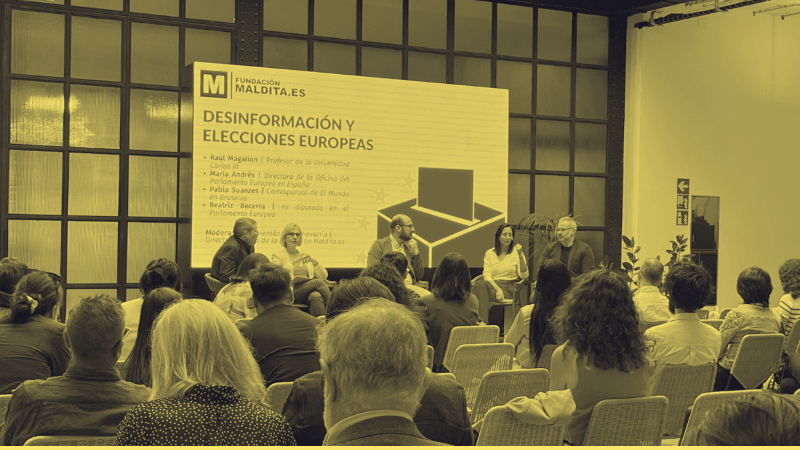
“We are better prepared than in 2019, but we are still in our infancy in 2024 compared to where we should be in the fight against disinformation,” said María Andrés, director of the European Parliament Office in Spain, during the event held on 27 May at the Larra Journalism Lab in Madrid.
Andrés highlighted the progress made during the last European legislature, such as new laws requiring platforms to moderate and remove false content or the online advertising transparency law. “The laws are there, we have reacted, we have understood that the problem existed. What we have done has been a steady effort: collaborating with fact-checkers, with media outlets, organising training, legislating… the conclusion is that we must fight on many fronts, in a highly coordinated way,” she added.
The director of the European Parliament Office in Spain pointed to disinformation narratives common across several European Union (EU) countries, such as those casting doubt on postal voting: “The intention is to create distrust, a narrative in which you can no longer trust what you used to trust; they make us doubt democracy.”
The panel, moderated by the deputy director of Maldita.es, Carlos Hernández-Echevarría, also included Beatriz Becerra, former Member of the European Parliament, Raúl Magallón, professor at Carlos III University, and Pablo Suanzes, Brussels correspondent for El Mundo.
For Becerra, European citizens have known “for a long time the problem that disinformation represents for democracy,” and to foreign interference have been added forms of disinformation “such as what we have seen during the pandemic or in the invasion of Ukraine.” The former MEP recalled that the EU had already drawn up an EU Action Plan against disinformation in 2018 and lamented that this plan encountered electoral and partisan interests when it came to being implemented in Member States. She also questioned “what we are doing in 2024 still talking at high levels of media and political representation about fake news, when fake news is a contradiction in terms. If it is false, it is not news.”
According to Suanzes, the risk of hoaxes about the EU is more linked to disinformation about legislative and decision-making processes than to Russian interference. “Being an EU correspondent is like explaining the result of a football match while having to explain what offside is in every report,” said the journalist. “If the audience does not fully understand the process, disinformation and manipulation become easier.”
“If there is one thing we know about these (European) elections, it is that the 72 hours before the electoral process are expected to be crucial from a disinformation perspective,” said Magallón.
The researcher also pointed out that targeted political advertising on social media allows political ads to be tailored according to age, gender or interests, making it possible in some cases to discourage participation and in others to foster polarisation.
“That is why the new rules of the game regarding electoral advertising are so important. And in almost every election there is still political advertising on Facebook and Google during the day of reflection and even on election day,” Magallón noted. “One of the things we should demand from electoral authorities and governments is that this must not happen again.”