
Social media is here to stay, and it is increasingly becoming a space for interaction among teenagers and young people. However, taking advantage of anonymity or certain legal loopholes, the online space has also become a setting for discrimination and harassment — a phenomenon that 38% of young people in Spain say they have encountered.
To help them identify hate speech and internalize the keys to combating it, Fad and Maldita.es — with the support of Google.org — have launched the app “No more haters. Break the chain of hate!”. Its goal is to encourage reflection and prevent expressions of hate and intolerance among young people aged 14 to 29, empowering them to become active agents in finding solutions and tackling hate. The project promotes the ability to identify hate speech, overcome prejudices and stereotypes, foster intercultural dialogue, and develop critical thinking skills for online interactions.
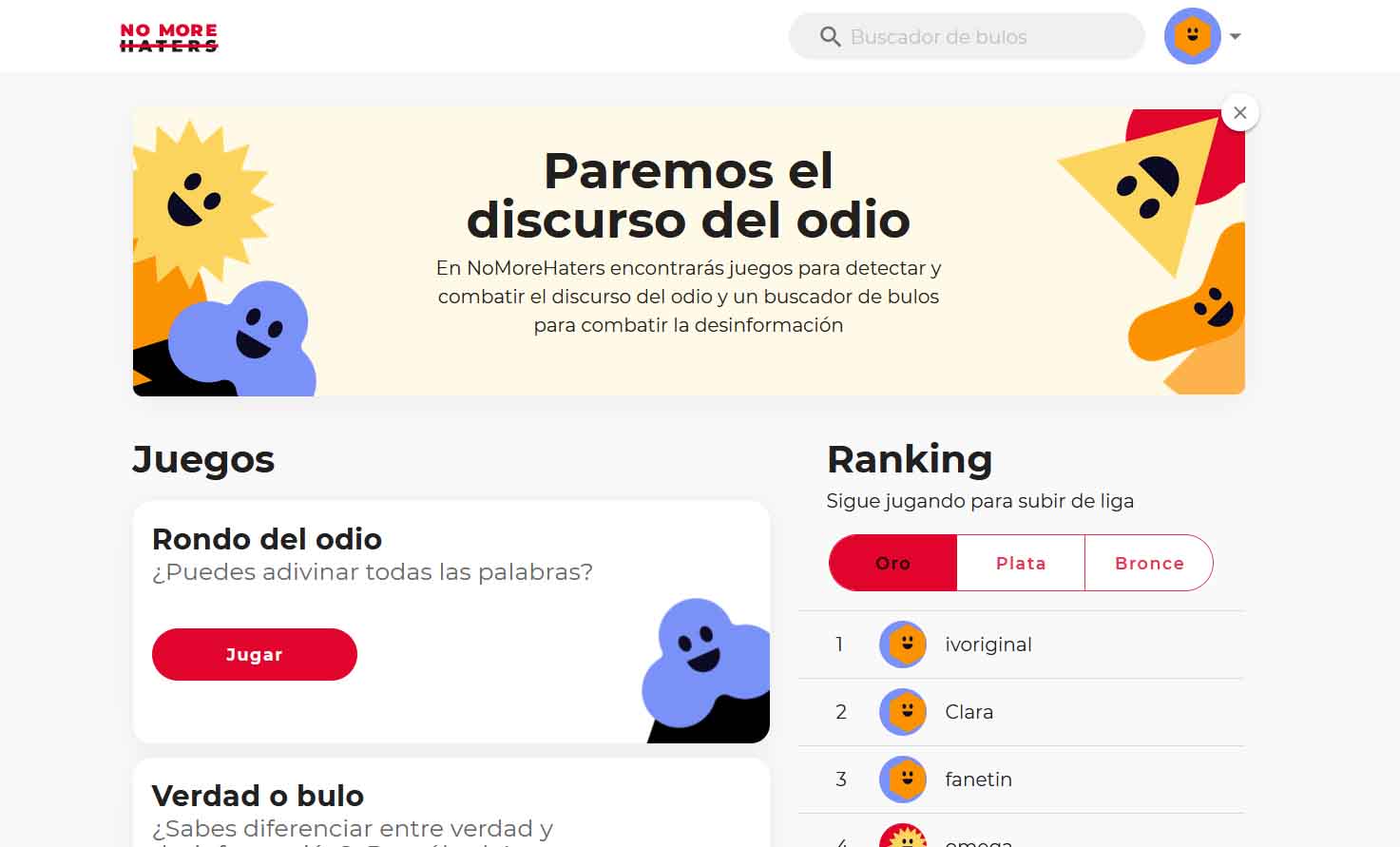
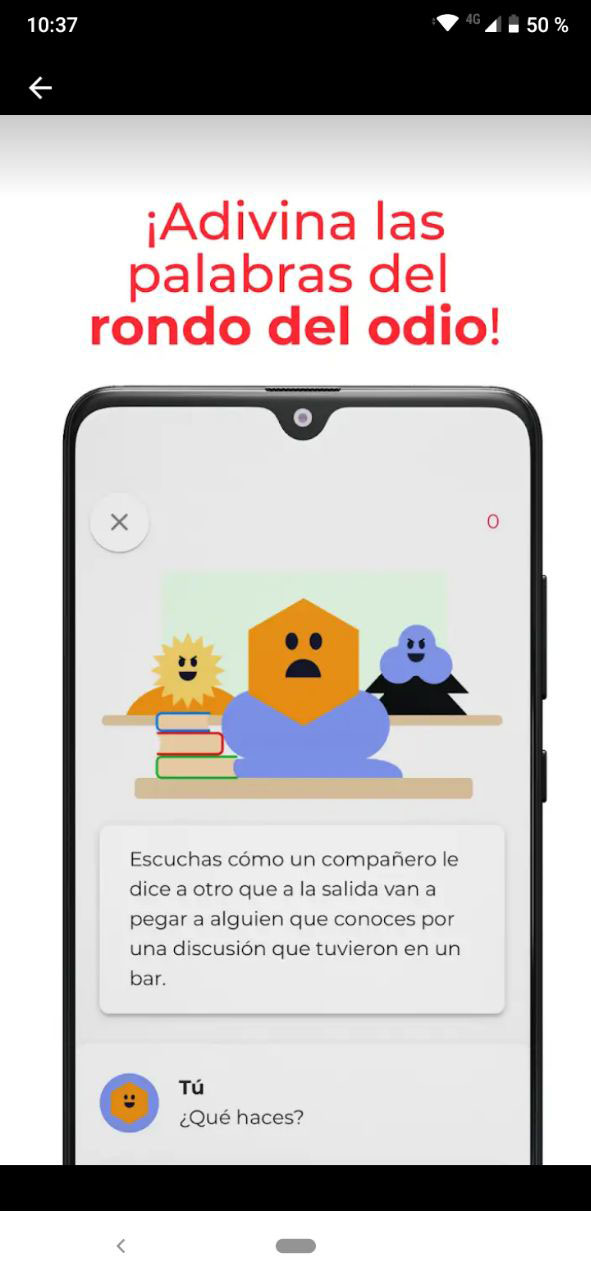
“No more haters. Break the chain of hate!” is a responsive web app, available in Spanish and English, aimed at young people aged 14 to 29. It includes games where users identify and respond to situations involving hate, earning points for correct answers. These games involve guessing hate-related terms, spotting disinformation, and role-playing scenarios as victims or witnesses to learn how to react. The app also features a leaderboard and a hoax search tool so users can check questionable content they encounter.
The web app can be downloaded from major platforms such as Google Play and the App Store, and it can also be played online at https://play.nomorehaters.es/. It includes a classroom mode, supported by a teaching guide designed for educators, with learning objectives, offline and online activities, and evaluation criteria. The guide and full project details are available at https://www.nomorehaters.es/.
Hate speech on social media
Fad and Maldita.es — with support from Google.org — launched the “No more haters. Break the chain of hate!” project last October to analyze and prevent hate speech on social media among Spanish youth aged 14 to 29.
In addition to the app, the project includes a sociological study to understand young people’s attitudes toward hate speech online, as well as a social media awareness campaign aimed at youth, to be presented in March.
Maldita.es co-founder Clara Jiménez Cruz stated: “Disinformation dangerously fuels hate speech and has found in social media the perfect channel to reach young people. These messages go against the plural, diverse and respectful education we should strive for as a society. With this project, we hope young people develop critical thinking and learn to identify this type of content.”
Fad’s director general, Beatriz Martín Padura, added: “One of the major problems with hate speech is that many young people do not know how to identify it. They may not realize that by sharing a meme that stigmatizes a group, they are contributing to hate speech. It is essential to train them to recognize and combat it, as they encounter these expressions of hate every day.”
What the data says
In Spain, data from the Ministry of the Interior shows that in recent years there has been a steady annual increase in the number of recorded hate crimes, including online hate speech. In 2017, the number of recorded incidents stood at 1,419; this rose by 12.6% to 1,598 in 2018, and reached 1,706 cases in 2019, an increase of 6.8%.
In that latest year, most incidents were ideologically motivated (34.9%), followed by those linked to racism and xenophobia (30.2%), and those related to sexual orientation or gender identity (16.3%). To a lesser extent (less than 4.5%), discrimination crimes were related to sex or gender, religious beliefs, disability, illness, aporophobia, anti-Roma sentiment or antisemitism. In terms of the type of offense, most cases involved threats (20.5%).
Meanwhile, a study carried out by the Reina Sofía Centre on Adolescence and Youth (Fad), based on a survey of 1,400 young people aged 14 to 24, found that 34% say they have suffered some form of abuse on the internet or social media (“unwanted jokes, exclusion, insults, threats…”), 9.2% admit having engaged in such behavior themselves, and a significant 38.1% report having seen, in the past year, “pages where people post messages attacking certain individuals or groups.”