
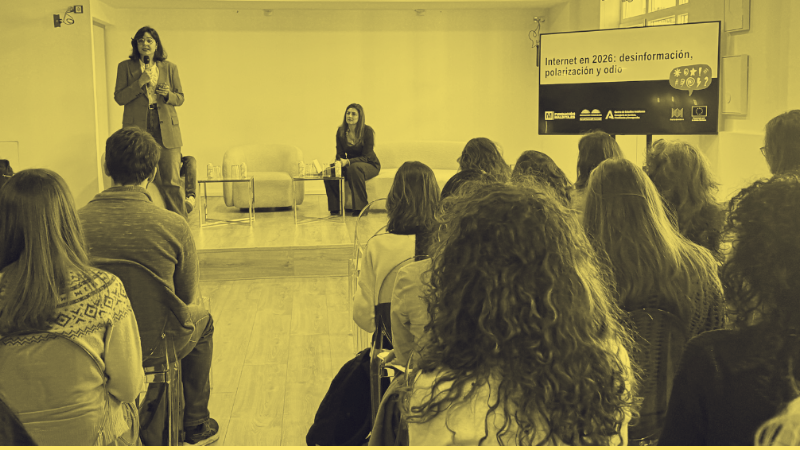
The internet’s public square has largely become a private space governed by private rules. What once emerged as a place of encounter, dialogue, and democratization of information has evolved into an ecosystem controlled by a handful of actors, where economic interests and specific ideological agendas prevail. This scenario, its risks, and possible responses to disinformation and hate speech were at the heart of discussions held at Madrid’s Palacio de la Prensa.
Organized by Fundación Maldita.es, Fundación Euroárabe de Altos Estudios, and Fundación Centro de Estudios Andaluces as part of the European project Hatedemics, the event brought together journalists, academics, analysts, and civil society representatives to reflect on the current landscape, its causes, its personal and social consequences, and possible paths forward.
The discussion began from the premise that we are living through a stage in which the internet and social media appear to have moved away from their original ideal of promoting knowledge and plural exchange. Transparency and user protection features are being rolled back, often under the banner of defending freedom of expression, but in reality aligned with economic and ideological interests. As Clara Jiménez Cruz, co-founder of Fundación Maldita.es, stated, this “makes us all weaker in the face of bullies, with fewer freedoms to make decisions and more easily manipulated as citizens.” She added: “A great deal is at stake in this second stage of the Internet. These actions have a devastating effect on our society because they are breaking the trust we had in one another.”
Alongside regulations such as the European Union’s Digital Services Act (DSA), which requires platforms to remove illegal content and prevent online manipulation, initiatives from civil society and academia are emerging to develop tools and strategies to counter disinformation and digital hate. But is it enough?
Online Hate Pushes People Out of the Digital Public Sphere
The conference opened with a panel featuring Mario Lara Delgado, head of section at the Spanish Observatory on Racism and Xenophobia (OBERAXE); Ángeles Blanco, board member for cooperation and hate crimes at FELGTBI+; and Cristina de la Serna Sandoval, Director of the Department of Equality and Anti-Discrimination at Fundación Secretariado Gitano. De la Serna stressed: “It’s not enough to delete illegal content once it is reported; we must also avoid promoting it and allowing it to gain greater visibility.”
The panel addressed both the problems and potential solutions related to online hate speech. Speakers emphasized how hate narratives often feed on disinformation and can become a first step toward eroding the rights of particularly vulnerable groups. As Ángeles Blanco noted, “Hate speech leads you to abandon the public space.” One of the greatest risks, participants warned, is that digital hate spills into the streets, as occurred in July 2024 in Torre Pacheco.
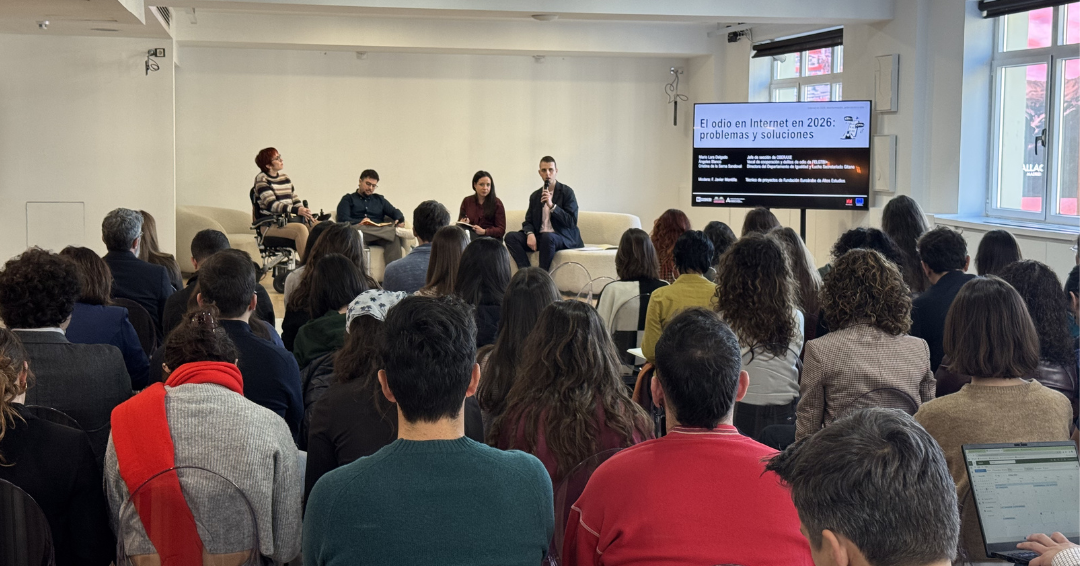
From left to right: Ángeles Blanco, F. Javier Montilla, Cristina de la Serna Sandoval and Mario Lara Delgado, jefe de sección de Observatorio Español del Racismo y la Xenofobia OBERAXE
As part of the proposed responses, Mª Eladia Illescas Estévez, Deputy Director of Research at CENTRA, and Eva Cataño García, researcher at CENTRA, presented HATEDEMICS, a two-year European project funded by the European Union and developed by a consortium of more than 14 partners from different countries, including Fundación Maldita.es. The project combines the work of fact-checking organizations, foundations, and academic teams. Its aim is to combat hate speech and disinformation through a technological tool grounded in a methodological, ethical, and human rights–based approach.
HATEDEMICS does not merely create a platform; it proposes a comprehensive process that begins with listening to experts and working with teachers and young people to analyze how disinformation and hate speech are interconnected, and to validate shared definitions and approaches to a complex and difficult-to-define phenomenon.
The outcome is an “ecosystem” with three interconnected levels: detection and mapping of hate narratives; AI-assisted generation of counter-narratives (supervised by professionals); and an educational laboratory focused on prevention and media literacy. The project is based on the premise that there is no single solution to combating hate and disinformation; technological intervention, critical education, institutional cooperation, and democratic strengthening are all required.
A More Polarized Internet Than Ever
Polarization, speakers recalled, is not new; it has always been part of public life. However, its intensity and dynamics are changing. During the conference, Marina Sacristán, Public Policy Officer at Fundación Maldita.es, presented the investigation “Inside the Polarization Industry on TikTok: How Money Is Made from AI-Generated Disinformation about Protests.” The research examines how TikTok’s design and monetization model incentivize the creation of generative AI videos on political content.
As Eva Campos, researcher and lecturer at the Complutense University of Madrid, explained, academic evidence suggests that social media act as catalysts of polarization, although they are not its sole cause. “Hoaxes and disinformation are a symptom, but media outlets have also surrendered to algorithmic logics in order to gain visibility, breaking their explicit social function,” she argued. Campos stressed that while access to content has never been greater, real spaces to build consensus have diminished, contributing to a sense of civic disorientation.
In the same vein, Javier Pérez, director of Political Watch, acknowledged that “We have had to give up on social media being a space for dialogue between citizens and politicians.” He argued that regulation is necessary but insufficient. Where regulation falls short, it is essential to rethink the role of public institutions and strengthen civic strategies. “As long as the internet does not strengthen democracy, we must strengthen other spaces outside the internet,” he said.
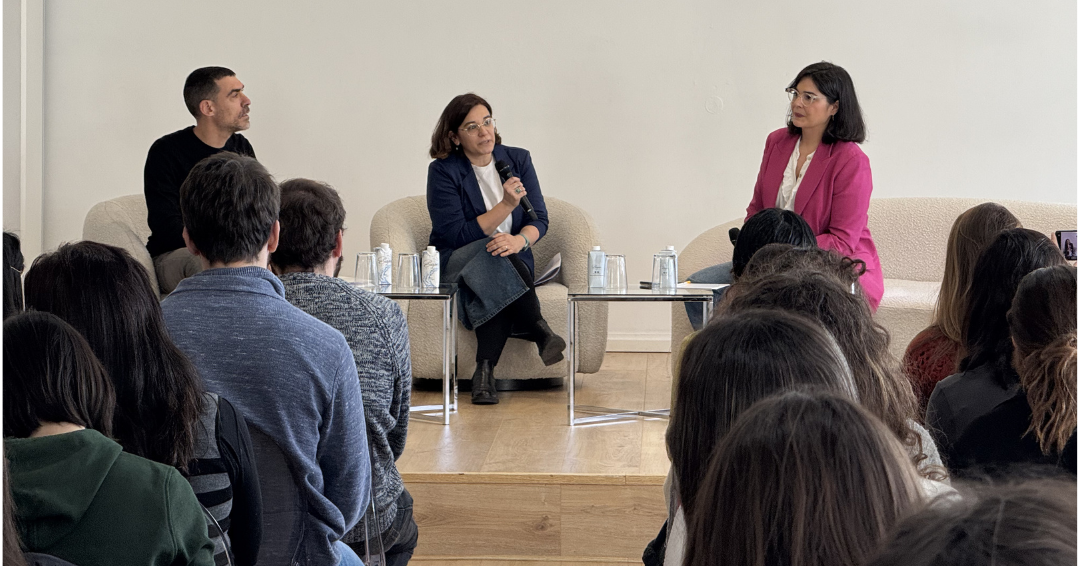
From left to right: Javier Pérez, Eva Campos and Clara Jiménez Cruz
Finding Quality Information Is Increasingly Difficult
Irene Lanzaco, Director General of the news media association AMI, noted that media outlets are seeking new strategies to build community and reduce dependence on major digital platforms: “Media are more widely read than ever, but there has never been so little control over their distribution.” Juan Zafra, Director General of the Club Abierto de Editores (CLABE), added that beyond diversifying content and producing quality journalism, the real and often exhausting challenge lies in reaching users who have less time and inhabit increasingly sophisticated algorithm-driven ecosystems.
Sara Campos, from the Digital Strategy team at the newspaper EL PAÍS, explained that major media organizations already operate under the assumption that social media generate little to no traffic to their websites. However, they maintain a presence there to stay connected with millions of people who consume news through those platforms. She also highlighted the role of tools such as newsletters in bypassing the mediation of large platforms and maintaining direct contact with audiences.
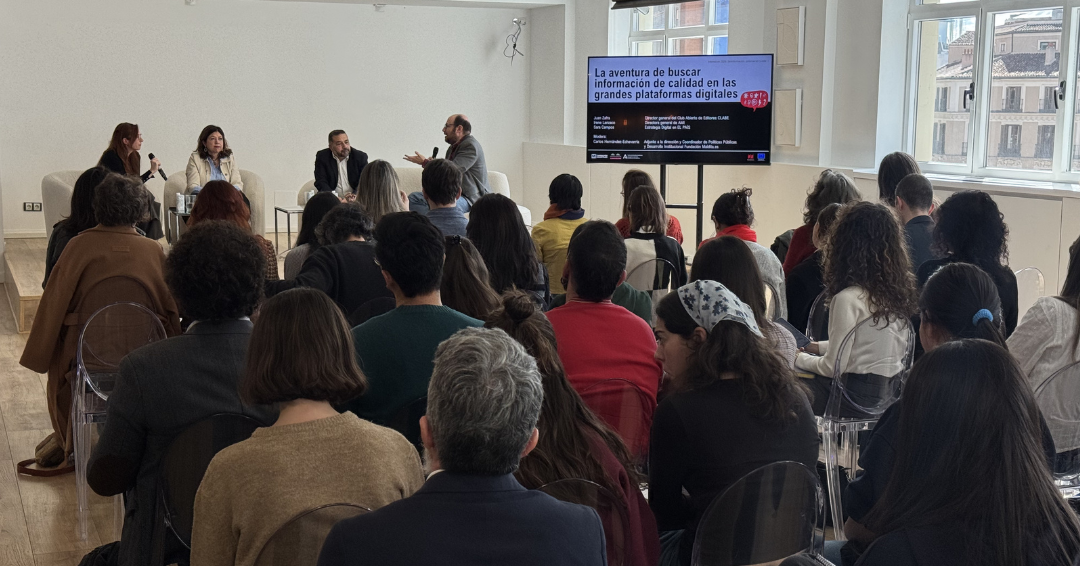
From left to right: Sara Campos, Irene Lanzaco, Juan Zafra and Carlos Hernández-Echevarría
The conference made clear that the present and future of the internet are not defined solely by the quality of public debate, but by our societies’ ability to sustain trust, protect rights, and foster spaces for coexistence. In the face of disinformation, polarization, and hate, the response cannot be purely technical or regulatory; it also requires civic commitment, responsible media, and strong institutions capable of reinforcing democratic values both online and offline.