
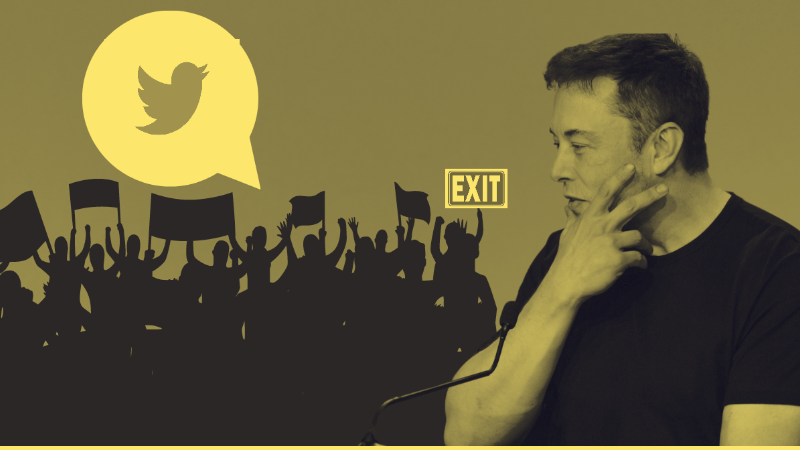
Let’s talk about that here: what the current state of disinformation on Twitter looks like and how it is used as part of a strategy that goes far beyond isolated hoaxes, embedding itself in narratives that take hold. Disinformers are winning the battle. (And also why we believe that leaving Twitter could be a mistake.)
Why we stay and fight on Twitter, and what we have (and can) change
You might think that disinformation has won on Twitter—and you might be right—but abandoning it only leaves people without reference points and gives disinformation a real free pass on the platform.
Twitter is more important than user numbers and academic studies would have us believe: this is where the most politically active people from across the spectrum are; people who want breaking news; people who care about politics. Are there fewer users? Yes. But they are the ones who are truly active. For worse—and, importantly, for better.
People are increasingly getting their information through social media, and Twitter is not only a primary actor in news consumption (its own platform) but also a secondary one (how tweets and screenshots of tweets go viral on other networks). For 18% of Spaniards, Twitter is still a news consumption tool, according to the Reuters Institute’s Digital News Report 2023—ahead of France (8%), the UK (13%), Germany (5%), Italy (8%), or the United States (14%).
Beyond this consumption, Elon Musk has explicitly pushed for Twitter content to go viral on other platforms under premises like “this is the truth,” “you won’t find it elsewhere,” “don’t believe the media”… and it works. Facebook, Instagram, and even TikTok are full of screenshots of tweets. With this, he has managed to create a kind of quasi-sectarian sense of belonging around the platform in the United States: an audience increasingly convinced that reality does not exist outside Twitter and that the media are lying.
Do we regain people’s trust by leaving?
We don’t think so. Those who don’t trust us will continue not to trust us; those who do trust us will keep doing so; and those who don’t have much time to verify, who dip in and out and receive content from Twitter, will be left abandoned.
Yes, there are bots. Yes, the algorithm promotes certain narratives aligned with what Musk wants. Yes, there is hate and a lot—a lot—of lies. We know this. But what does leaving actually achieve?
For Musk, advertisers and revenue don’t really matter. This isn’t an economic investment; it’s an investment in a disinformation weapon. And it works. And if those of us who fight disinformation—media outlets, journalists, and people who care about being informed and not getting fooled—leave, what’s left on Twitter? Active disinformers influencing a large number of people without barriers—far more people than some like to believe, and people who are not leaving the platform.
Being present on other platforms besides Twitter is an obvious yes; believing that a mass migration away from Twitter is going to happen seems far less realistic.
Then there’s the unicorn thinking of creating massively successful platforms outside the capitalist framework. That may be fine for a university lecture, but realistically, the war is here—and abandoning it means leaving wounded people on the battlefield.
Musk has also repeatedly claimed that Twitter is a media outlet, advertising it as the largest source of information in dozens of countries, equating it with The New York Times. He wants substitution. If we leave, we hand it to him on a silver platter.
This idea of Twitter being a “media outlet” brings us back—ironically—to the question of what a media outlet actually is. If a website allows lies to run rampant, should that really be considered a media outlet? It’s time for the profession—not politicians—to define what a media outlet is.
From Maldita.es, beyond not leaving Twitter, we believe we need to double down on the fight on this platform, knowing we are in hostile territory. And we need to use it to learn how disinformers act and collaborate, how they communicate, and to listen to them—because they do it very well.
- Listening to what’s happening: isolating yourself on other networks from the narratives being generated—whether disinformative or hateful—hides a real panorama that later reaches people on other platforms. Closing your eyes won’t stop lies on Twitter.
- Calling it out: to denounce what happens here, you have to be here. To call out Musk’s lies and those of his platform, you have to be here.
- The narrative: Musk’s false idea of “free speech” has won in the United States. We are not in favor of removing content, but allowing disinformation to go viral without labeling lies—especially the most harmful ones (health, science, emergencies…)—is not freedom; it’s algorithmic tyranny. And we haven’t known how to fight it. Now that same fight is moving to Europe.
- Europe as Musk’s target: he has set his sights on European attempts to fight disinformation, accusing them of censorship. Leaving the platform won’t help; it just puts us in a mode of running away. We need to stay and act.
- They are a community: Musk has built a strong community within Twitter that goes beyond algorithmic manipulation. They believe in his mission because he is “standing up to the bad guys” (us, the media).
- The image of the media: we still think we’re amazing, while fewer and fewer people read or listen to us. Leaving doesn’t seem like a good solution when the battle is being fought on this platform; it only strengthens the dichotomy Musk promotes: the media versus me.
- Professionalizing the fight against disinformation in Community Notes: Musk wants fact-checkers out of Twitter; he has even publicly complained about groups of people in the U.S. collaborating on Community Notes. For him, Community Notes are cosmetic—甚至 an excuse to spread disinformation. Let’s try to build a community that verifies and hacks them with data and fact-checks. And let’s call out those who receive the most Community Notes without correcting themselves.
- Comments: at one point, comments were supposed to save democracy—people contributing, building, improving articles. Let’s be honest: today, comments are just another space for hyper-active activism. A place for trolling. A place where, even if you tell the truth, twenty people will accuse you of the opposite. It’s their terrain; let’s not give them victories. Is it less democratic to close comments in this disinformative ecosystem? No.
- Superspreaders: a concept often used negatively—people who endlessly disseminate disinformation. They are active. They collaborate. It’s time to collaborate too, and to create groups on Twitter and beyond of people who want to help stop lies.
- Tools for citizens: tools to help detect and report bots; to help spread the truth; to highlight who is repeatedly flagged with Community Notes. Knowledge enables faster action.
- Not all platforms are the same: we’re not saying others are good or charitable, but there is one—Twitter—that openly refuses to comply with European regulation, that has embraced borderless disinformation, and that will have the support of a Trump administration to try to bypass any attempt to stop disinformation. Let’s be precise when we generalize.
- Legislation: we must pressure the European Union and the Commission not to cave to Trump’s demands to avoid acting against Musk’s companies—particularly Twitter—and its refusal to apply the disinformation risk mitigation measures required by the Digital Services Act (DSA) and the Code of Practice on Disinformation.
- We don’t know how many people is “a lot” of people: right now, many people announce they are leaving Twitter, but similar boycott attempts in the past came to nothing. It looks like a mass exodus that will hurt Elon Musk—but when you look at the numbers, user figures barely drop. What does happen is that those who leave do so because they reject disinformation, while the vast majority who stay will be exposed to the messages of those who remain. And the disinformers stay—all of them. It will be easier for their narratives to take hold among remaining users if there are no counter-narratives and no reliable information to neutralize them.
***We know Twitter is now called X, of course, but for editorial reasons and clarity, we continue to call it Twitter.