
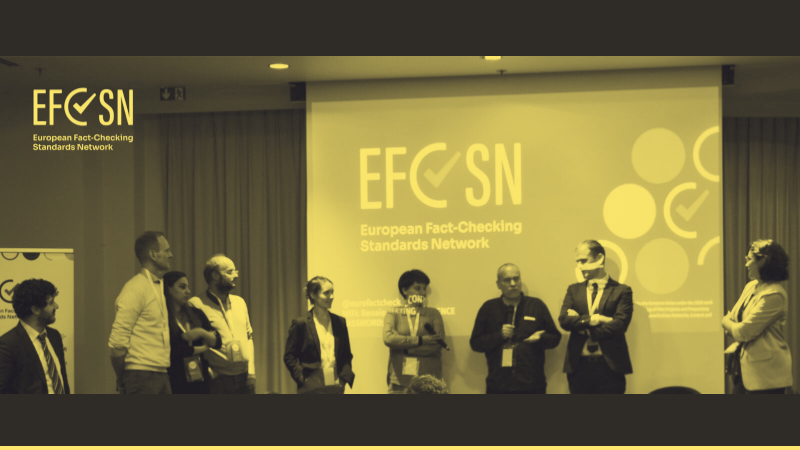
Throughout this year, the EFCSN has brought together nearly 50 fact-checking organisations from across Europe in a project led by Maldita.es to draft a Code of professional standards that verification organisations must meet in order to join the association. Obtaining EFCSN membership means that an organisation operates independently, ethically and with a commitment to serving the public interest.
The president of the EFCSN’s governing body, Maldita.es co-founder and CEO Clara Jiménez Cruz, opened the event by highlighting the EFCSN’s aim of serving as a representative voice for fact-checking organisations that meet the standards of the Code, which range from non-partisanship to the quality of sources and financial transparency.
In her speech, Clara Jiménez Cruz explained that the EFCSN is “a very demanding organisation, which has pushed its members to strive for excellence and incredibly high standards, while at the same time reflecting the experiences of those organisations already involved”.
“Transparency is our shield against distrust, collaboration is our weapon against disinformation,” she added, referring to the strict level of transparency required by the Code and the extraordinary capacity for cooperation that the fact-checking community has demonstrated over the years and which has been formalised with the creation of the EFCSN.
The event included discussions with other stakeholders working in the field of combating disinformation, such as a debate on the role of fact-checkers in shaping public policy in Europe with Krisztina Stump from the European Commission’s Directorate-General for Communications Networks, Content and Technology (CNECT), Bulgarian MEP Eva Maydell (EPP), governing body members Tommaso Canetta (Pagella Politica, Italy), Gülin Çavuş (teyit, Turkey), David Schraven (CORRECTIV, Germany), and the association’s treasurer, Vincent Couronne (Les Surligneurs, France).
Maydell warned about the current “pandemic of disinformation”, although she expressed optimism that “fact-checkers can inoculate the public through their work via media literacy campaigns”. Krisztina Stump, for her part, said she was confident in the new efforts being made in Europe, such as the Code of Practice, to which Maldita.es is a signatory, which imposes new requirements on major digital platforms to tackle disinformation. “Today we have all the elements – with the EFCSN and our Code of Practice – to address disinformation,” she said.
Members of the governing body Stefan Voss (dpa, Germany), Ana Brakus (Faktograf, Croatia) and Thomas Hedin (TjekDet, Denmark) also discussed, together with Sophie Eyears, Strategic Partner Manager for News Integrity Europe at Meta, whether European fact-checking organisations and digital platforms should work together and how to do so. Eyears pointed out that “more than 190 million pieces of disinformation content have been labelled thanks to the collaboration programme with fact-checking organisations”, something Meta would not have been able to achieve without the fact-checking community. The event also included the participation of a Global Public Policy representative from Google, who ultimately could not attend due to unforeseen circumstances.
Ana Brakus, also a member of the governing body, called on platforms to be more transparent about their initiatives and to invest more resources in the fight against disinformation. She emphasised that “platforms can improve the infosphere, but they need to decide to do so” and urged them to “use their resources to create something good”.
The conference concluded with a speech by Delphine Colard, Head of the Spokesperson’s Unit and Deputy Spokesperson of the European Parliament. She underlined the European Union’s aim to continue promoting democracy and truth and mentioned that “the Kremlin’s disinformation war shows the danger of disinformation and propaganda”. Finally, she added that “fact-checkers are like referees who ensure fair play”.
Members of the governing body have also met in recent days in Brussels with members of different Permanent Representations of European member states to present the EFCSN, its Code and its objectives.
This project is part of the European Commission’s Call of Integrity of Social Media and is led by six European organisations focused on the fight against disinformation: Fundación Maldita.es (Spain), AFP (France), CORRECTIV (Germany), DEMAGOG (Poland), Pagella Politica/Facta (Italy) and EU DisinfoLab (Belgium).
You can read more about the EFCSN on its website. Follow the EFCSN on Twitter and LinkedIn for regular updates on this project.