
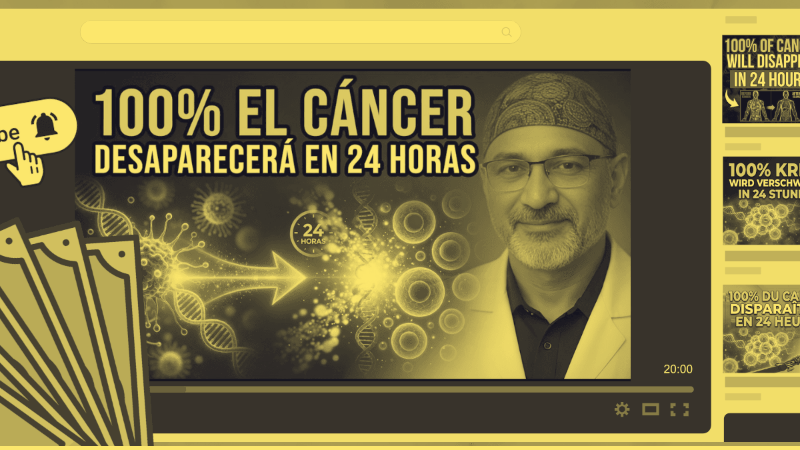
They all claim to be doctors and define themselves as oncologists in their videos, but none of them are real people. “Dr. Richard Ben" or “Dr. Rafael Carvalho” are AI-generated characters who have YouTube channels where they promise something no oncologist would ever commit to: making cancer disappear in just 24 hours. A lie that could endanger millions of cancer patients and one that allows them to earn money with the percentage they take from the advertising YouTube includes in its videos.
When they claim that the "100% of cancer will disappear in 24 hours," these accounts do so in the thumbnails of the videos. The thumbnail is the image that accompanies the video title in search results or YouTube menus. According to the platform itself, the thumbnail is fundamental for a video to be successful as YouTube's recommendation algorithm takes those clicks into account to show the video to more users.
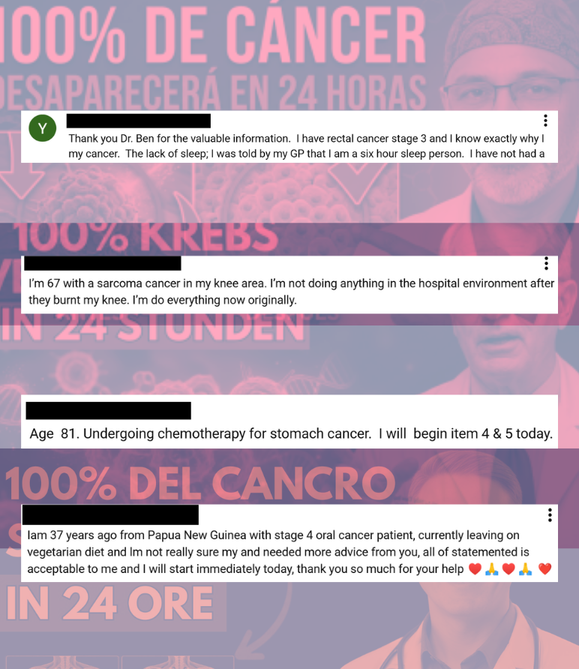
In the video itself, the AI-created “doctors” give diet tips or remedies to lower the risk of cancer but at that point they've already attracted many people with the promise of cures. Just 20 videos from these channels have accumulated over 1.7 million views and 4,275 comments, many of them from desperate patients or their relatives. Almost all of them believing they are talking to a real doctor.
YouTube does not act (and funds many of these channels)
Impersonating a doctor is a crime in many countries. In Spain, Article 403 of the Penal Code punishes those who perform "acts proper" to a profession such as medicine without holding the corresponding degree, and more severely those who publicly claim to be doctors without possessing the necessary qualifications. Furthermore, the Supreme Court has assessed in its rulings that some convicted of this crime had taken advantage of the deception by creating “the widespread belief” that they were real doctors through “staging”, like the AI doctors do on YouTube: white coats, stethoscopes, surgical scrubs…
We have reported 20 videos to YouTube through its website, one from each channel, for being illegal content. We have also informed YouTube that the video thumbnails promised to cure cancer in 24 hours. YouTube has confirmed receiving our complaints and on occasion has asked for more information, but 72 hours after reporting them all the videos were still available on the platform..
The law is not being followed, nor are YouTube's own rules, which prohibit "content that poses a serious risk of egregious harm by spreading medical misinformation" and specifically "Content that claims that there is a guaranteed cure for cancer outside of approved treatment." Furthermore, YouTube not only allows these "AI doctors" to promise miracle cures on channels with up to 145,000 subscribers, but it also pays them for doing it.
Using different tools such ss YTLARGE and TubePilot, we have verified that 45% of the channels are “monetized”. That is to say, that YouTube is placing advertisements on content whose revenue is then shared with the channel managers.
Legal responsibilities
According to the EU Digital Services Act or DSAm YouTube needs to remove or block illegal content on its platform after being notified of it, or else be held liable from that point forward for any damages it may cause. Furthermore, according to the same law, YouTube is a "very large online platform" and as such has additional obligations.
The most important is to assess the systemic risks arising from its services and implement effective risk mitigation measures regarding them. Article 34 specifically requires platforms like YouTube to assess the systemic risks arising from the design and operation of its service, in particular the dissemination of illegal content, but also other phenomena that may have negative effects on public health.
In this case, YouTube has not only failed to act on our reports of illegal content for at least 72 hours, but our research shows that it has not effectively mitigated the risk of this kind of accounts exploiting different parts of their platform to spread content that is illegal or harmful to public health. The data from this analysis demonstrates this: the volume of views for just 20 of their videos (1.7 million) is much greater than the total number of subscribers to their channels (145,000). This is a usual indicator of content amplification through recommendation algorithms. Besides, 45% of accounts have benefited from YouTube monetization by receiving a share of the revenue from ads on the channel; that is to say that the platform has financed the production of this type of highly harmful health misinformation.