
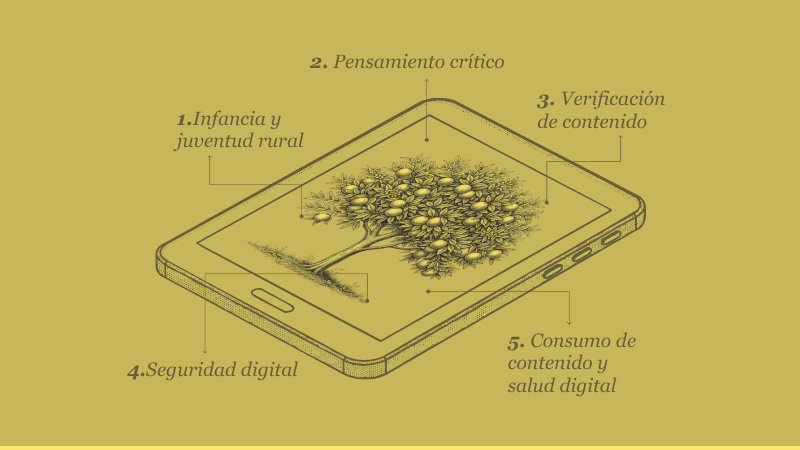
The 2026 Educational Needs Assessment Report of the RURCODE project, which brings together Fundación Maldita.es (Spain), Federación Valenciana de Municipios y Provincias (Spain), La Columbeta (Spain) and Connect Brussels (Belgium), reveals a gap between rural young people’s perception of their digital verification skills and the strategies they actually use to check information.
72.7% of rural young people aged 8 to 16 believe they are able to detect false content online. However, only 45.5% look for the source when something seems suspicious. This gap between what young people believe they can do and the strategies they actually use to verify information is one of the main findings of the first report of the European project RURCODE (Rural Youth Co-Designing their Digital Education).
The report also identifies a shift in the way young people search for information, with a gradual move away from traditional search engines towards social media and artificial intelligence tools. As they get older, platforms such as TikTok and ChatGPT become increasingly prominent compared with Google, pointing to an information environment that is increasingly mediated by algorithms that personalise content and make verification more challenging.
The study, conducted with young people in Cantabria, Valencia and Brussels, examines how they access information, which platforms they use, what risks they encounter and what educational needs exist around media literacy in rural environments. The findings are based on eight focus groups conducted between March and April 2026 with 55 young people aged 8 to 16, as well as a questionnaire completed by 25 teachers and educators. The results will provide the basis for developing free, practical educational materials for teachers, co-designed with young people themselves.
Key findings
The challenge is no longer access to the internet, but how it is used
For years, discussions around the digital divide in rural areas have focused on access to technology and connectivity. However, RURCODE's findings point to a different reality. The young people who took part in the study are widely connected, use multiple digital platforms and access online content and information on a daily basis. The challenge is no longer whether they can connect, but how they navigate an increasingly complex digital environment, shaped by artificial intelligence, social media and an overwhelming amount of information.
From Google to ChatGPT, YouTube and TikTok: new gateways to information
One of the report's most significant findings is the change in the sources young people use to search for information. Although Google remains the most widely used tool overall (76.4%), ChatGPT is already in second place (52.7%), reflecting the growing role of artificial intelligence in young people's information habits. However, usage varies significantly by age. Among children aged 8 to 11, Google remains clearly dominant (94.7%), followed by YouTube (52.6%) and ChatGPT (47.4%). Among adolescents aged 12 to 16, the picture changes considerably: TikTok becomes the leading source of information (70.6%), followed by ChatGPT (64.7%), while Google falls to third place (35.3%). These figures show a gradual shift, as young people get older, from traditional search engines towards social media and AI tools. These platforms were not originally designed as search engines, often provide fewer opportunities for verification and use algorithms to personalise the content users see, potentially reinforcing pre-existing ideas.
They are confident in their ability to detect disinformation, but do little verification
The research reveals a significant gap between perception and practice. While 72.7% say they believe they can identify false content, reflecting a high level of self-perceived critical ability, this does not necessarily indicate a verified capacity to do so. When asked about their verification habits, only 45.5% say they look for the source when something seems suspicious.
Advertising, violent content and emotional distress: risks are part of their digital experience
Exposure to digital risks is part of participants' everyday experience. 100% say they have seen advertising online. In addition, 67.3% have encountered videos showing fights, insults or other aggressive content. The most concerning figure appears among adolescents: 94.1% say they have felt sad, worried or anxious after consuming digital content. Exposure to harmful content has become widespread.
Teachers want to address these challenges, but need support
Most of the teachers surveyed consider media literacy an increasingly important need in the classroom and express an interest in working on skills related to verification, critical thinking, artificial intelligence and digital safety. However, they also identify significant barriers, particularly lack of time, specialised training and materials adapted to their needs.
A European project designing solutions with rural young people
RURCODE (Rural Youth Co-Designing their Digital Education) is a project funded by the European Union through the CERV programme. It is led by Fundación Maldita.es together with Federación Valenciana de Municipios y Provincias (Spain), La Columbeta (Spain) and Connect Brussels (Belgium).
Based on the findings of this report, the project will develop free, multilingual media literacy materials co-designed with young people from rural areas, with the aim of strengthening their digital skills and their ability to participate critically and confidently in the digital environment.