
At Maldita.es, the community is one of our pillars: now we need you more than ever in our fight against disinformation to be more effective. The more people we have detecting and reporting hoaxes through our WhatsApp bot (+34 644 22 93 19), sharing fact-checks, and contributing their “superpowers” to debunk falsehoods, the more effective we will be in this battle. We also need resources: become an ambassador and support us with your contributions so we can remain independent and grow even stronger.
On the occasion of the launch of the Maldita.es Foundation against disinformation — journalism, education, research and data in new formats — and taking advantage of #GivingTuesday, we want to thank you for standing by us in this fight and share with you a toolkit to help you avoid being misled. In the spirit of this day, share it with anyone you think might find it useful!
Tools so you don’t get fooled
Verification toolbox
One of our classics: here you can find many of the tools we use daily to verify disinformation. Check the origin and first use of images, locate photos using maps, verify weather conditions on a specific date, trace the origin of a video… You’ll find instructions on how to use them, and our colleague Andrés Jiménez also explains how to do reverse image and video searches.
Our guides so you don’t get fooled
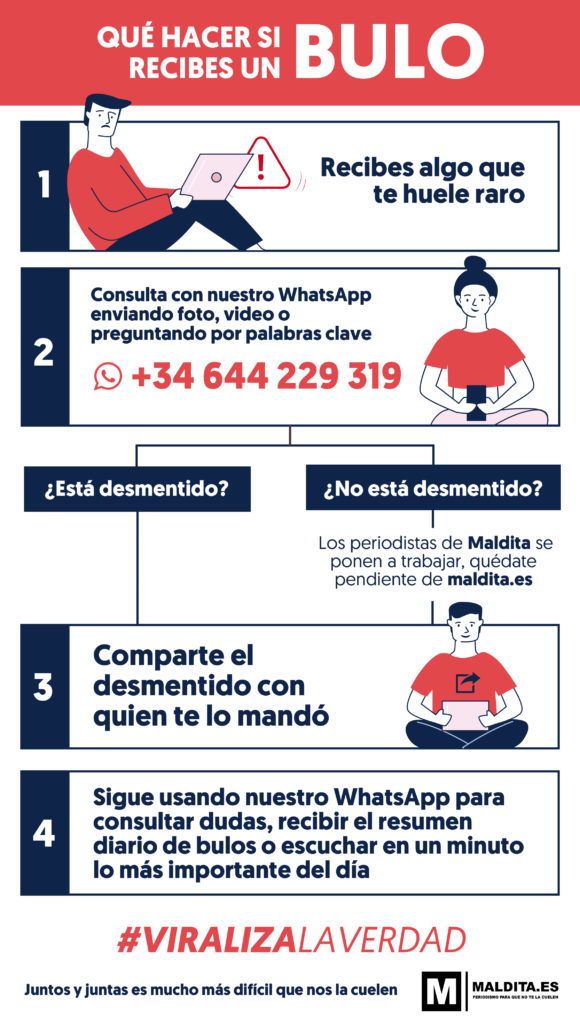
How do we distinguish truth from falsehood? What are the keys to avoid being misled? How do we tell science from pseudoscience? In our guides you’ll find all the answers. And above all, remember: if something seems suspicious, don’t share it — ask us on WhatsApp ( +34 644 22 93 19)!.
Maldita.es browser extension and app
Whether you browse more on your phone or your computer, these tools help you encounter fewer hoaxes. The browser extension and Android app will alert you if the content you are reading has been debunked. You can also consult our fact-checks and political verifications there.
Protect your privacy, data and money
Five simple habits can improve your online security
Digital alternatives for everyday use
At Maldita Tecnología we have created a small repository of open-source tools, many of which are managed collaboratively rather than by large tech corporations. This helps prevent the improper handling of personal information that identifies us and belongs to us. Remember: your data is gold!
How to know what information companies have about you, prevent them from using it without consent, and report misuse
How to avoid online scams
Online shopping is a space where the bad guys are always on the lookout. Whether they want your data or your money, you can never be too careful when entering your personal and card details on a website. Knowing the key steps to protect yourself from scams when shopping online can save you a lot of trouble, and it also helps to understand what phishing is and how to avoid falling for it, although no one explains it better than our colleague from Maldito Bulo, Luisa Bernal:
Tips to fight disinformation
Of course your brain is going to try to fool you! The brain has to process a huge amount of information all the time, so it uses mental shortcuts to make daily life easier. But sometimes those shortcuts can lead us to wrong judgments or mistaken interpretations: these are cognitive biases. We give you 5 tips so your brain does not fool you, with the help of Cristina López Tarrida, an expert in social engineering and psych hacking.
Being aware of our biases is one of those tips. There are many of them, but at Maldita.es we have identified twenty of the most common biases so that you can stay alert to them. Come on — learning to spot our biases takes practice!
But it is not only your brain that may fool you: people who spread disinformation often use, intentionally or by mistake, arguments that seem valid but are not. These are called logical fallacies. There are many types, but at Maldita.es we explain some of the most common ones so they do not fool you.
How to talk to a loved one who spreads hoaxes and conspiracy theories
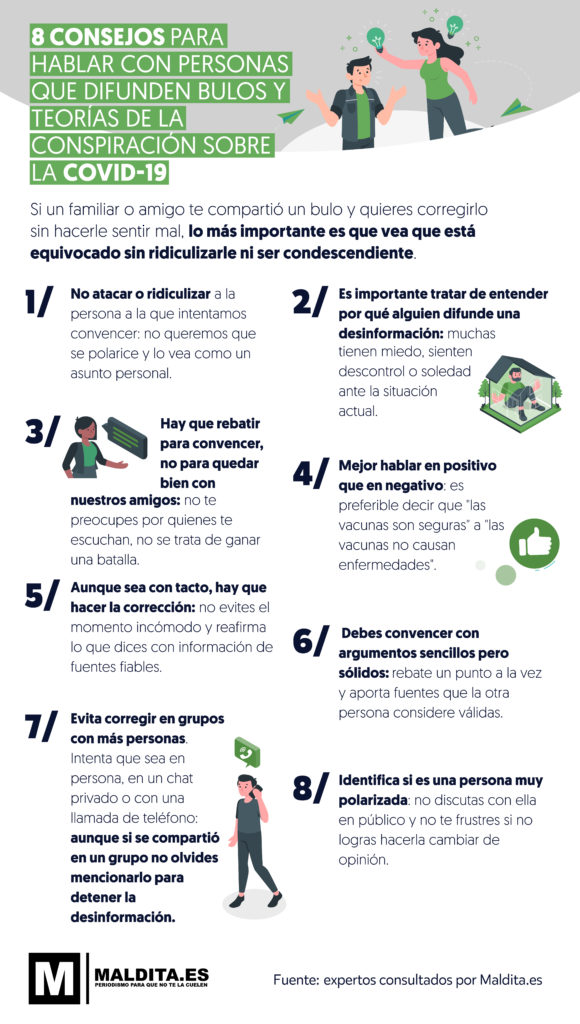
Someone shares a hoax or a conspiracy theory on WhatsApp, or during a conversation, and you do not know how to react — is there a more awkward moment? It is even more difficult when that person is a loved one whom we do not want to make feel bad, because we know they are not doing it with bad intentions. It is important to know how to show them they are wrong without ridiculing them or being patronizing, since otherwise they may reject our explanation. We explain how to do it in this infographic:
We hope all these tools and resources are useful to you! Remember to share them with others: the more people fighting hoaxes, the more effective our battle will be. Together, it is harder for them to fool us!
Help us keep creating resources like these — become an ambassador.