
Spain is the third European country where disinformation causes the greatest concern. These are findings from the Digital News Report 2025, which analyzes 48 countries across five continents, 25 of them in Europe. In Spain, 69% of people say they are concerned about disinformation, compared to a global average of 58% and a European average of 54%.
This is the 14th edition of the report, which this year looks at which social media platforms are perceived as posing the greatest disinformation threat and whether citizens in each country have received media literacy training. In Spain, the survey was conducted by the University of Navarra. These are the five key takeaways from the report.
Spain is one of the European countries where concern about disinformation is highest
69% of Spaniards say they are worried about what is real and what is false online, a figure that places Spain among the countries with the highest level of concern among the 48 analyzed in the report. Globally, Spain ranks ninth, with a level of concern 11 percentage points above the global average of 58%. In Europe, Spain ranks third, behind only Portugal and the United Kingdom, and 15 points above the European average. Compared with the previous year, the figures are very similar: concern drops by one point, from 70% to 69%, and only 9% say that disinformation does not worry them.
Looking at respondents’ age, there is an increase in concern among both the youngest and the oldest groups. The highest level of concern is among people aged 65 and over, rising from 73% to 74%. Among young people, the share of those concerned increases by three points, from 63% to 66%.

TikTok and Twitter (now X), the social networks perceived as posing the greatest disinformation threat
Three out of four respondents (73%) point to a social network or video platform as a major threat when it comes to disinformation. TikTok (48%) is the platform most often mentioned in relation to this threat, followed by Twitter (46%) and Facebook (41%).
23% of Spaniards turn to fact-checkers when they suspect information may be false or misleading
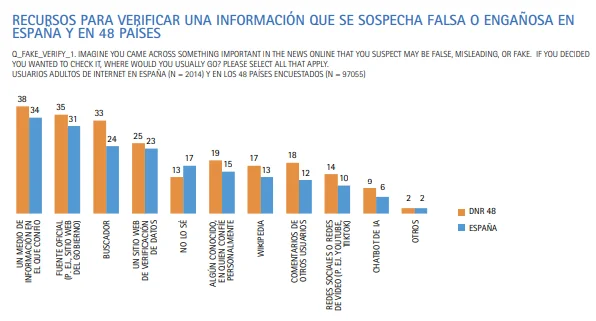
The survey also asks what people do when they doubt whether something is disinformation. The chart shows that, overall, people in Spain verify information less than in other countries. When they do check, Spaniards most often turn first to media outlets they trust, followed by official sources and fact-checkers. Among fact-checkers, Maldita.es and Newtral stand out.
Only 18% of citizens have received some form of media literacy training
This year, the Digital News Report looks at media literacy and finds that it is not very widespread. In Spain, only 18% of respondents say they have received training related to the use of information, 74% say they have not, and 8% are unsure. This places Spain slightly below the global average.
There are also clear differences by age. Among those under 35, nearly a third of respondents have received some form of training, while among those over 55, barely 10% have had any.
WhatsApp is the most widely used social network and the second most used for news
When it comes to social media use, WhatsApp clearly remains in first place. YouTube stays in second position and rises slightly, while Instagram and TikTok are also on the rise.

When asked which social networks people use to get news, WhatsApp shares the top spot with Facebook, with 24% of respondents saying they use them for news. Overall, news use of these platforms has declined compared to the previous year. Only Telegram increases, from 7% to 8%, while TikTok remains stable at 11%.
Age plays a major role in news use. Twitter, TikTok, Instagram, and Telegram are clearly used more for news among those under 35, while YouTube, WhatsApp, and especially Facebook are used much more by people over 35.
You can consult the global report in Spanish from the Reuters Institute at the following link. You can also check the data on Spain here.