

The BuloBús, supported by the Google News Initiative, aims to help the public detect hoaxes and scams circulating online and on social media—content that people can easily fall for due to lack of awareness—and to provide them with tools to fight disinformation.
Several journalists and trainers from Maldita.es will travel on the BuloBús, and in each town there will be a range of activities related to combating disinformation. These include an information stand and a public help point, operating from 10:00 a.m. to 2:00 p.m., located in a central public space in each town. At this point, educational materials adapted for older audiences will be distributed
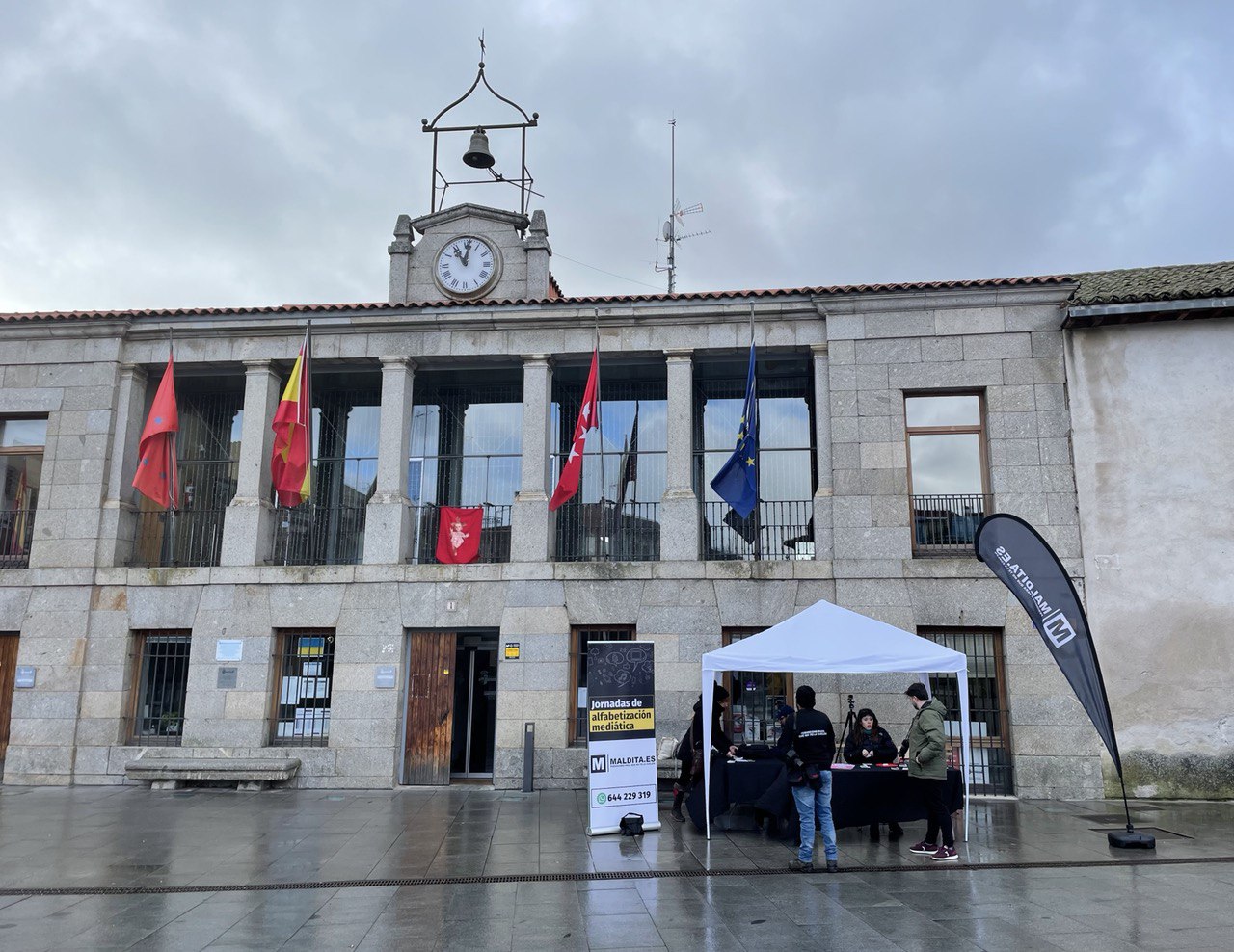
There will also be a workshop for young people aged 14 to 18 on disinformation and cybersecurity, as well as an entertaining theatre performance and a game aimed at continuing to raise awareness about the dangers of disinformation and its consequences. The theatre performance will be narrated by journalist Julia Otero.

During the time the BuloBús remains in each municipality, Maldita.es journalists and trainers will offer personalised support and provide advice, as well as the technological and journalistic tools needed to protect against disinformation and online scams.
The first stop of this caravan will take place in La Roda (Albacete) on 11 April, on a route that will continue through Cieza (Murcia) on 13 April and Burriana (Castellón) on 15 April. Below is the full list of municipalities where Maldita.es will be present until 20 May, which can also be consulted on the BuloBús website:
- La Roda (Albacete), 11 de abril
- Cieza (Murcia), 13 de abril
- Burriana (Castellón), 15 de abril
- Torredembarra (Tarragona), 17 de abril
- Calatayud (Zaragoza), 19 de abril
- Alfaro (La Rioja), 21 de abril
- Barañáin (Navarra), 22 de abril
- Llodio (Álava), 24 de abril
- Castro Urdiales* (Cantabria), 26 de abril
- Langreo (Asturias), 28 de abril
- Mora (Toledo), 3 de mayo
- Herencia* (Ciudad Real), 5 de mayo
- Linares (Jaén), 6 de mayo
- Montoro (Córdoba), 8 de mayo
- Calamonte (Badajoz), 10 de mayo
- Barcarrota (Badajoz), 11 de mayo
- Béjar (Salamanca), 13 de mayo
- Toro (Zamora), 15 de mayo
- Allariz (Ourense), 16 de mayo
- Bueu (Pontevedra), 19 de mayo
This project is part of Maldita.es’ commitment to promoting media literacy among citizens of all ages and socio-cultural backgrounds. Every year, Maldita.es trains more than 2,000 people through courses and workshops specifically designed for older people, students, young people and professionals, with the aim of improving their ability to identify disinformation.
Disinformation worries six out of ten Spaniards
Since the advent of the internet, the way we communicate and access information has changed. Today, disinformation reaches users directly through mobile phones, social media, email, messaging platforms and buy-and-sell websites.
Disinformation affects not only how we vote, but also how we consume, which school we send our children to, or which medical treatment we choose. According to the Reuters Institute’s Digital News Report 2022, 62% of Spaniards are concerned about the spread of online disinformation. Meanwhile, 35.4% of people who do not verify potential hoaxes admit that they lack the necessary knowledge to do so, according to a survey published by Spain’s National Statistics Institute (INE) in 2021. This figure rises to 50.4% among people over the age of 65. In addition, within this age group, more than two million people live in municipalities with fewer than 10,000 inhabitants.
“The world in which we consume information has changed, and it’s easier for hoaxes and lies to slip through; that’s why we need to relearn how to distinguish information from what is not. And this is not just for children,” says Clara Jiménez Cruz, CEO of Fundación Maldita.es. “There is a lot of talk about media literacy in schools, but we want to focus on older people living in towns and villages, who feel unprotected against online disinformation and do not feel they have the digital skills to confront it. This BuloBús will go from town to town, providing a public service right where people are, to support them.”
“During the uncertain times of recent years, it has become clearer than ever how important it is for people to have access to accurate information and to be able to distinguish fact from fiction. Google News Initiative is supporting Maldita.es, experts in fact-checking, to provide training and support to older people in communities across Spain. In this way, we ensure that people throughout the country have access to the skills and technology needed to help combat disinformation,” said Matt Cooke, Director of Google News Initiative.
*Municipalities marked with an asterisk were pending confirmation as of 10/04/2023.