
Street actions in squares, buses and bars
We have taken to the streets not once, but many times. In 2019 we organised an “Emergencia Bulera” at Matadero Madrid to fact-check possible hoaxes live ahead of the general elections. A year later, in the middle of the COVID-19 pandemic, we reached bus shelters in 55 Spanish cities with posters to raise awareness about the incorrect use of face masks. We did this in collaboration with JCDecaux and the doctors and illustrators “Yo, Doctor”, who designed this campaign and also created a series of cartoons illustrating Maldita.es debunks about the coronavirus.

The campaign Stop.Verify.Share. also reached buses in Madrid, Barcelona, Zaragoza and Seville. In this case, Maldita.es and Oxfam Intermón joined forces to combat disinformation about migrants and provide tools to identify hate speech.

With the BuloBús, a project developed with the support of Google News Initiative, we travelled to around twenty Spanish municipalities to help older people identify hoaxes and online scams. We did this by visiting town and city squares with informative materials and the play “Que no te la cuelen”, based on real examples such as the bitcoin scam.

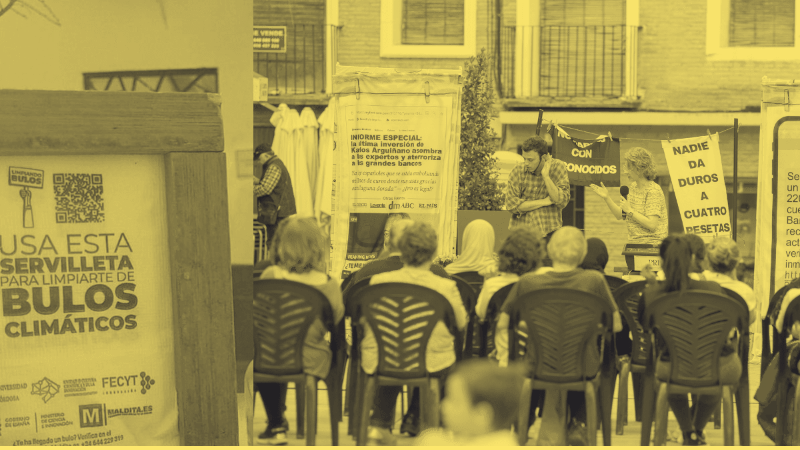
What else could we do? Go to bars. So we joined the “Limpiando Bulos” campaign by the Scientific Culture Unit of the University of Córdoba (UCO) to debunk myths and disinformation about climate change. As a result, 70,000 napkins were distributed in bars in Córdoba with a QR code that, when scanned, gives access to 10 infographics debunking climate change hoaxes.

Games to debunk disinformation
Who doesn’t like playing games? In the virtual escape room “La fábrica de bulos”, the player takes on the role of an investigative journalist who must uncover a plot spreading hoaxes about migrants. It can be played in Spanish, English and Italian and includes a teaching guide that you can request by emailing [email protected].

You can also try the No More Haters online games, which will train you to identify hate speech affecting groups such as the LGTBIQ+ community, migrants or the Roma community. They can be played on both mobile and computer, in Spanish or English, and are a very useful resource for secondary school students (spoiler: the “Rondo del odio” game is addictive).
If you prefer offline games, you can print our Comebulos, Comebulos Migration Edition or the game Truth or Hoax Coronavirus Edition.
We even went to camp!
Around 60 young people aged between 13 and 17 took part in Maldita.es’s Youth Anti-Hoax Camp in October 2023, funded by the Erasmus+ programme. The participants attended online training sessions and spent a weekend in Toledo. There, through games, a scavenger hunt and a content creation lab, they developed a social media campaign to fight online disinformation.

Learning through WhatsApp
Our WhatsApp chatbot (644 22 93 19) is not only useful for verifying potential disinformation. Through the chatbot, users can take the microlearning course “5 challenges against hoaxes”, with short videos and quizzes to learn how to recognise hoaxes and scams, all in just 25 minutes.

Our courses and the play “Que no te la cuelen” have also reached Orange stores and its Orange Digital Center with a free course on online hoaxes and scams.
An exhibition and many free-to-use materials
Maldita.es has also taken part in the exhibition “Fake News. La fábrica de mentiras” at the Espacio Fundación Telefónica in central Madrid. Through historical pieces, works by contemporary artists and real case studies, the exhibition reviewed how hoaxes have been created and transmitted over the centuries, prompting reflection on the impact disinformation currently has on our society.

Courtesy: Espacio Telefónica
If you want to see all our free-to-use resources, you can check the Maldita Educa Cortesía: Espacio Telefónica and to stay up to date with our new tools, you can subscribe to the Maldita Educa newsletter.