

In the fight against disinformation, fact-checkers use many tools to check whether the content circulating online is real. Many of them involve the use of technology. But there are times when, in addition to more specific verification techniques, we also have to rely on classic journalism: pick up the phone and ask the press offices of institutions, political parties and scientific organisations.
That is how we have been able to debunk claims that a politician made statements they never actually made, posted a tweet they never wrote or approved a measure that does not exist.
Disinformation is a problem, and it is important for the press officers of institutions or political parties to be aware of this. In order to do our work at Maldito Bulo, we apply our methodology, which is public and which states in several points that a response from the institution or person affected by the disinformation is necessary in order for us to classify it as a hoax.
In this article, we explain the reasons why everyone benefits when press offices answer the questions fact-checkers ask in order to debunk a piece of content, no matter how obvious the hoax may seem.
1. When we decide to debunk a piece of content, it is because it is going viral or because of how dangerous it is
Our methodology is very clear about the reasons why we decide to debunk a hoax. We do not debunk content that has had very limited circulation unless it poses a danger: we do not want to amplify a hoax with little reach. There are, however, moments of crisis, as happened during the coronavirus pandemic or when natural disasters occur, for example, in which disinformation can pose a problem for people’s health. Another moment of crisis can arise during election campaigns, when disinformation can undermine the foundations of the electoral system.
Therefore, when we make the decision to fact-check a potential hoax, it is because it is potentially dangerous or because we know it is going viral. How do we know? We have tools to identify it.
Many times, when a piece of content goes viral on a social network such as Twitter or Facebook, it has already circulated beforehand on private channels such as WhatsApp or Telegram. Through our WhatsApp chatbot (+34 644 229 319), we receive content that is circulating, including material being shared on WhatsApp. If something reaches us several times in a short period and, moreover, arrives marked as “forwarded many times”, we know that content is being widely shared.
For these reasons, we have a more complete view of the degree of virality of a possible hoax than the press offices of some institutions, political parties or scientific organisations. And if we contact them, it is precisely because we know that something is circulating widely and, in some cases, their response is essential in order for us to say that something is false, according to our methodology.
2. Yes, people are believing it
There is content that spreads and that, when we first see it, we may think nobody is going to believe because it is satire, a joke that makes us laugh as soon as we see it, or because it seems obviously false.
But our experience as fact-checkers tells us that we have to stop thinking like an elite: not everyone has to know everything, and when something goes viral as if it were real, it is because people are believing it. Nor can we ridicule those who believe it. A hoax may not fool us this time, but it may catch us out on another occasion.
One example is this headline that circulated years ago: “They discover a mosquito that can get you pregnant with a single bite.” However funny it may sound, we had to debunk it because many people were sharing it thinking it was real.
We have many examples of this kind, including more recent ones, in which at first glance it may seem too obvious that the circulating content is false and that, therefore, people are not believing it, but in reality it ends up going extremely viral as if it were real.
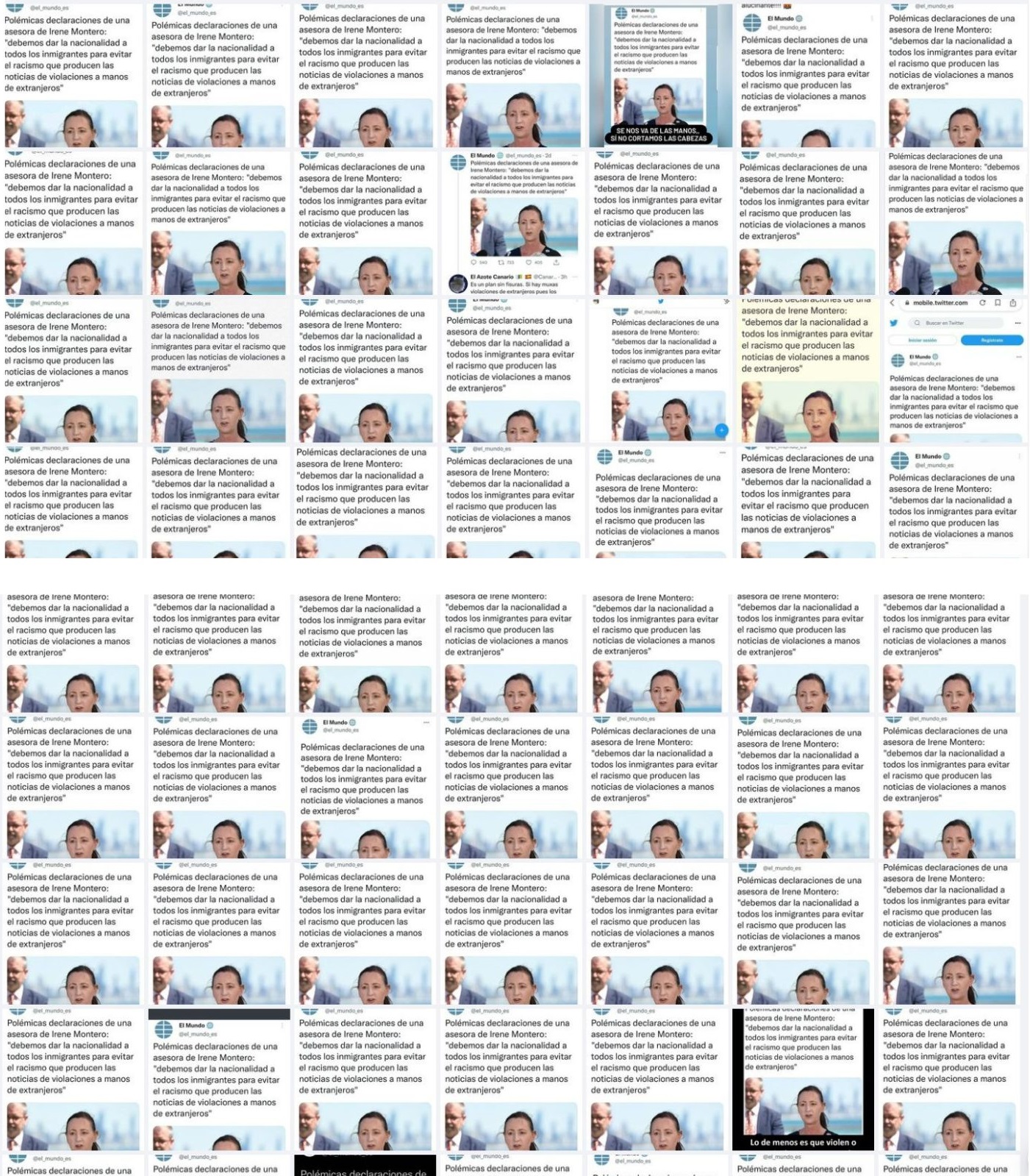
This was the case with a tweet posted by an account describing itself as a “parody” and impersonating the newspaper El Mundo on Twitter. The message put in quotation marks some supposed statements by an adviser to the Minister for Equality, Irene Montero, alongside a photo of a woman. That person was neither an adviser to Montero nor were the statements real. However, the tweet was shared widely as if it were from El Mundo, and many people believed it. Screenshots of the tweet spread to other social networks, where they were shared hundreds of times.
3. Publishing a debunk helps flatten the curve of disinformation
There are hoaxes that go viral very quickly and reach a large number of people in a short time. That was the case with the audio in which the then Minister of Foreign Affairs, Arancha González Laya, supposedly confused the then US president-elect, Joe Biden, with Bin Laden.
Researcher Mariluz Congosto, who specialises in discourse analysis on Twitter, carried out an analysis of the evolution of this hoax once it reached that network. Before getting there, it had already gone viral through WhatsApp, as we were able to confirm from the number of queries our chatbot received about this audio from people who had received it on their mobile phones.
At Maldita.es, we published the debunk the morning after it began circulating on the messaging channel the previous night. According to Congosto’s data, obtained from the analysis of tweets mentioning the hoax versus those sharing the debunk, the debunk “drastically slowed” the spread of the hoax on Twitter.
Indeed, part of our response to disinformation consists of encouraging the community to share debunks. Sharing the debunk helps make the truth go viral and, in the best-case scenario, the debunk would reach people before the hoax itself. That way, anyone who receives it later already has the tools to know that what they have received is not true and not to keep sharing it.
As we can see, publishing a debunk helps curb the curve of disinformation.
4. If a debunk has been published, people will find it if they search for the hoax
Related to the previous point, there will be people who receive a piece of content and search for it, either to read more about the topic or to find out whether it is true or not.
If the content is a hoax and there is a debunk published, anyone searching for it will find the debunk and will have at hand the tools needed to know that what they have received is not true.
In general, not everyone has the time to verify everything they receive or see on social media, so a debunk published by reliable fact-checkers makes it much easier for those people to know they are dealing with disinformation.
5. Failing to debunk only allows disinformation to flow unchecked
On the other hand, failing to debunk a hoax that is going viral will only mean that the content continues circulating without any kind of restraint.
Verification tools are available to everyone, but experience also tells us that if fact-checkers do not do this work, it will be more difficult for everyone who receives the hoax to check whether it is true or not.
Without a debunk explaining why it is a hoax, disinformation will find it easier to keep spreading. By contrast, the sooner we publish the debunk, the sooner the curve of disinformation begins to flatten. And with the collaboration of press offices, our fact-checks can be published more quickly.
6. The debunk gives people a tool to stop the lie in private and family networks
A debunk gives people who receive a hoax the possibility of sending it to whoever is spreading the disinformation, which means we are giving them a tool to stop the lie.
In fact, we need that intervention. Fact-checkers can monitor the disinformation circulating on public networks such as Twitter, Facebook, Instagram or TikTok. By contrast, WhatsApp conversations are private and end-to-end encrypted, so we cannot enter them to see what is circulating.
That is why it is important both for people to send us what is circulating through our WhatsApp chatbot, so that we can identify the disinformation and decide what to debunk, and for users to have that tool to stop the hoaxes circulating through messaging channels.
7. If there is a debunk, our WhatsApp chatbot will automatically reply to anyone who sends us the hoax
We log suspicious content that may be disinformation, whether people ask us about it via WhatsApp, our social media channels or email, in our database, and every time someone sends it to us we record a recurrence. That is how we know something is circulating.
That database is connected to our WhatsApp service, so if we link a debunk to a hoax, every time someone sends it to us, the chatbot will automatically send them the fact-check. Once again, we will be giving users of private networks tools to help stop disinformation.
8. A hoax can go viral again, and having a debunk helps stop it sooner
Hoaxes circulate, and it is possible that when one goes viral there is a peak of disinformation which then, apparently, stops circulating or at least stops doing so with such force. But over time many of these hoaxes are shared again and, if that happens, there will already be a debunk to stop it.
This happens so often that at Maldita.es we have given them a name: we call them “zombie hoaxes”, disinformation that reappears after a few months. There are many examples of this kind, and one of the clearest for us is the case of the false police alert Manitas Limpias. It is a hoax that has been circulating for years and that we debunked in 2019, but which comes back strongly from time to time through WhatsApp. For a while, it seems to have stopped spreading, and then one day we start receiving several queries about the same content.
You have asked us about it more than 1,000 times, but when it comes back, we have the debunk ready to hand, and it reaches every person who asks us about this hoax. That is how we help prevent it from spreading even further.
9. Our methodology requires us in some cases to have an official response in order to say that content is a hoax
Our fact-checks, with their different categories (Hoax, There is no evidence, or What we know), are subject to a strict methodology that must always be followed before we can publish them. That is why, in addition to knowing it very well, a team of editors reviews each article before publication and at least four of them must give their approval before it is published, so that nothing slips through.
That methodology provides that, for content to be classified as a hoax, there are cases in which we need the press teams of institutions, political parties or scientific organisations to answer the queries we send them.
Although there are times when, with other evidence, we can know that something is a hoax, we still have to follow our methodology because it is the only way to do our work as transparently and rigorously as possible. That means yes, we do need a response from press offices.
On more than one occasion, a press team has told us they would not answer our query about a piece of content because it was “too obvious” that it was disinformation. But because they did not want to respond, we were unable to publish the debunk, or we had to change its category according to the methodology, moving from being classified as a hoax to being classified as unsubstantiated disinformation.
So however obvious the hoax may seem, we need that response.
10. We are more likely to believe hoaxes we have seen many times
Each and every one of us has biases that, at times, make our brains fall for something false. One of these biases, the backfire effect of familiarity, means that the more times we are exposed to a piece of content, the more likely we are to accept it as true.
If we do not make the effort to produce a debunk and try to stop that hoax from spreading, it will continue to circulate and will reach not only more people, but it is also possible that those who have already seen it before will see it more than once again (the same hoax or others on the same topic). That makes them more likely to believe it.
Ultimately, it is important for press offices to collaborate in the fight against disinformation, however obvious a hoax may seem. As fact-checkers, we have tools to know when something is going viral and whether people are believing it. If we contact a press team, it is because it is necessary, and the collaboration of press offices is important in order for us to publish a debunk quickly. The sooner we publish, the sooner the curve of disinformation begins to flatten.