
This is a multifaceted problem that requires a multidisciplinary response from an independent body that is not controlled by the Government. The battle must be fought through journalism, education, technology and independence.
Disinformation is a problem that affects not only our democracy, but Democracy as a whole, and its solution cannot depend solely on the Government. It must be built through collaboration between different actors who independently fight falsehoods. Only in this way can the fundamental right to freedom of expression be guaranteed.
Maldita.es was part of the European Commission’s High-Level Expert Group on fake news and disinformation. In the report we drafted — which served as the basis for the Action Plan against disinformation presented by the European Commission in 2018 — a skepticism toward any content regulation was clearly expressed. The report also included a series of recommendations, notably the need for a collaborative approach involving all relevant actors, with a structured process to document progress and identify those who fail to take responsibility.
The European Commission itself, in its public consultation on the European Democracy Action Plan, mentions the option of creating independent oversight bodies with investigative powers as a possible national-level measure to strengthen the monitoring and enforcement of electoral rules and support election integrity. At no point does it propose that these bodies should depend on member states.
The fight against disinformation: a matter of State, not of parties
Not involving the opposition in seeking solutions to a national problem undermines those solutions. Not involving journalists, media outlets and press associations shows a lack of understanding of how to tackle the issue. And not involving independent fact-checkers means that any verification attempt by such a body would lack credibility, making the problem even worse.
What has been approved?
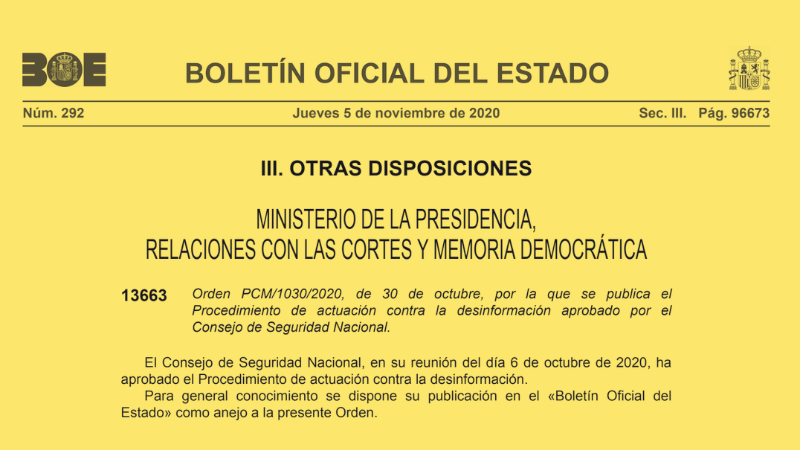
The main issue is that it is so ambiguous that it is not entirely clear. On November 5, the Official State Gazette (BOE) published the “Procedure for action against disinformation,” approved by the National Security Council on October 6, 2020. What does this plan say?
According to the BOE, this governmental procedure aims to “improve and increase transparency regarding the origin of disinformation and the way it is produced and disseminated, as well as to assess its content,” and has the following objectives:
-
Identify and define the bodies, agencies and authorities involved in the system.
-
Establish levels for prevention, detection, early warning, analysis, response and evaluation.
-
Describe the specific tasks involved at each level in the fight against disinformation.
-
Define mechanisms for information exchange at strategic, operational and technical levels.
-
Determine mechanisms for evaluating the implementation and functioning of the procedure.
-
Define a methodology for identifying, analyzing and managing disinformation events.
-
Propose the framework and composition of an ad hoc working group to develop and review a National Strategy against Disinformation.
The procedure includes six responsible bodies: the National Security Council, the Situation Committee, the Secretary of State for Communication, the Permanent Commission against Disinformation, the competent public authorities, and the private sector and civil society. However, for the latter it is stated that “their collaboration may be requested” if “considered relevant.” In other words, they are not necessarily included, despite being key to the solution.
And many questions remain:
- Who will decide what is true and what is not? Who will decide what gets checked?
- Who will decide what is monitored? Based on what methodology?
- What is “fake news”? Can an opinion be considered one?
- Who would order the removal of content?
- If it is a judge, who reports false content to prosecutors?
- Will websites be shut down? Who will decide that?
- What defines a “fake news website”?
- What happens if those websites operate from abroad?
- How will governments deal with disinformation formats like images, WhatsApp chains or screenshots?
- Will there be investment in media literacy?
The mere possibility of creating “ministries of truth” by governments raises concern. Not involving political parties, press associations, experts, constitutional lawyers or independent fact-checkers calls into question whether such a body could truly be independent.
Governments should not debunk content from media outlets — nor should a committee appointed by a government. Otherwise, who will uncover the government’s own falsehoods?
Fighting disinformation requires independence, methodology, non-partisanship and transparency. Yes to collaborative, multidisciplinary and independent bodies — but a firm no to bodies appointed by governments.
Hours after its publication in the BOE, the Secretary of State for Communication issued a clarification stating that it would “in no case monitor, censor or limit the legitimate right of the media to provide information” and that its aim is to prevent foreign interference. However, the wording remains so ambiguous that it is open to interpretation.
Monitoring disinformation threats is already part of European strategy. But monitoring citizens and media to potentially censor them is something entirely different. If that is the intention, we oppose it. The Government must clarify that the sole purpose is to address foreign interference — something that is not clearly stated.
The role of governments in fighting disinformation
Should governments be involved? Yes — but not in a partisan way that increases polarization or restricts rights. The fight cannot happen without media organizations, without media literacy efforts, and without independent fact-checkers.
Governments should support independent journalism and fact-checking, promote media literacy, and work with platforms to improve transparency and reduce disinformation. What they should not do is appoint committees to decide what is true.