
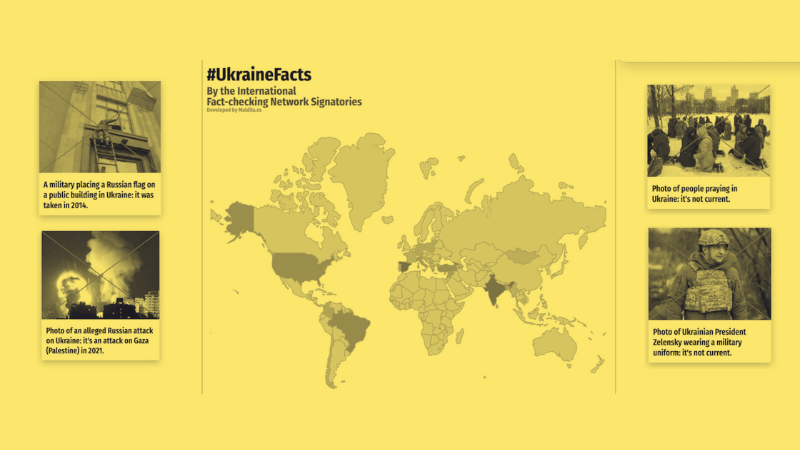
In #UkraineFacts you will find in which countries each disinformation content has been detected and access the debunks of the different fact-checking organizations that have investigated it.
How was #UkraineFacts created?
When Maldita.es’ team woke up on February 24 with the news that the Russia’s invasion of Ukraine had begun, it was easy to guess that it would be accompanied by a wave of disinformation. Attempts to deny victims of the attacks, videos and photos about the Russian attacks on the Ukrainian population that in reality were not, but created disinformation chaos: images from the past, from other conflicts, from events not related to wars and even taken from video games.
We had a second intuition: these hoaxes and disinformation would not only be circulating in Spain, but throughout the world. We decided to open a database and give access to more than 100 fact-checkers worldwide to start collaborating.
In crisis we know that disinformation circulates very quickly and that one of the ways to limit the impact of disinformation is to debunk it as quickly as possible, which is why collaboration between fact-checkers is key. Three days after the invasion began, that database already has over 300 entries from fact checkers in 35 countries and is growing by the minute with input from our partners around the world. This database, in addition to allowing us not to duplicate efforts investigating the same thing, also allows us to know when each disinformation began to circulate in each country. We are seeing how, unlike with COVID-19, when each piece of disinformation could take weeks to jump from one country to another, in this case it is going viral in disparate parts of the world at the same time. Misinformation circulating on the same day in 17 countries at the same time.
With this database, Maldita.es has developed a map that allows access to the denials of the most viral hoaxes. In #UkraineFacts you can see in which countries each disinformation has been detected and access the denials of the different verification organizations that have investigated it.
The community of signatory organisations of the Code of Principles of the International Fact-checking Network will continue to feed this database in the coming days and analyze the data to better understand this wave of disinformation.