
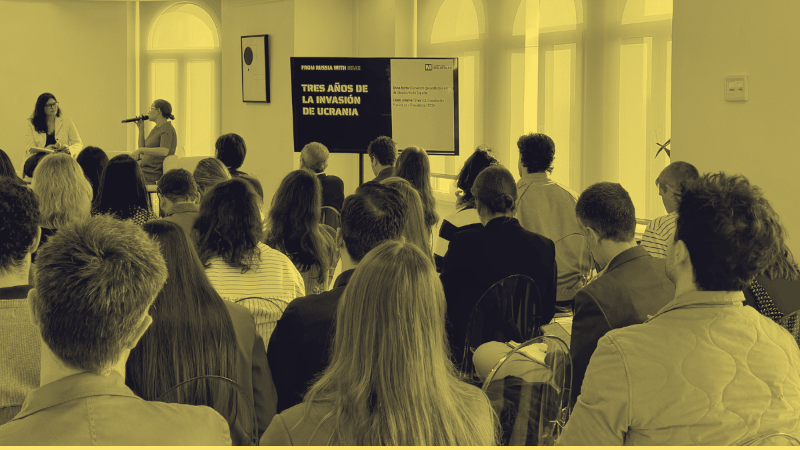
Clara Jiménez Cruz, CEO of Fundación Maldita.es, opened the event with a reflection on the uncertainty that characterizes our times, a perfect breeding ground for disinformation. Maria Margarete Gosse, Germany’s ambassador, spoke about how hoaxes are part of our daily lives and the need for tools to tackle disinformation. The UK ambassador, Alex Ellis, emphasized the importance of fact-checking organizations in countering the speed at which disinformation spreads, especially on social media. Roel Nieuwenkamp, Ambassador of the Netherlands, highlighted the work his country is doing to support fact-checkers in order to strengthen citizens’ media literacy.

Anna Korbut, geopolitical analyst and editor of UkraineWorld Español and an expert on disinformation, shared her experience of the early days of the conflict in a conversation with Clara Jiménez Cruz. Korbut expressed optimism about the situation in Spain, noting that although Russian disinformation campaigns have had some presence, Spanish society appears to be “vaccinated” against these influences due to its strong commitment to democratic values. However, she warned that the normalization of violence could generate uncertainty among the population.
Spain as a target of Kremlin disinformation
In the panel “Spain as a target of Kremlin disinformation,” experts analyzed how Russian propaganda adapts to different audiences and manages to resonate within Spanish society. Xavier Colás, El Mundo correspondent for Russia and Ukraine, explained that in Europe the aim is to generate skepticism about aid to Ukraine, while in Russia the goal is to justify military difficulties by blaming that support. Marina Alonso, researcher at the General Gutiérrez Mellado University Institute, explored the adaptability of disinformation campaigns to the political and social contexts of each country: whereas they once focused on military intervention, they now target economic, social, and political spheres. Félix Arteaga, researcher at the Elcano Royal Institute, emphasized the importance of taking measures to counter disinformation. In this context, the speakers agreed on the importance of media literacy in addressing its impact in Spain.

The fight of European fact-checkers against Russian disinformation: countering disinformative narratives through collaboration
Fact-checkers from Ukraine, Romania, and Georgia explained how Russian disinformation affects their countries and democratic processes. Yevhen Fedchenko, co-founder of StopFake (Ukraine), pointed out that narratives once considered marginal—such as accusations against the family of Ukrainian President Zelensky or theories about biological laboratories in Ukraine—have entered mainstream discourse at key moments. Elena Calistru, President of Funky Citizens (Romania), explained how disinformation has adapted to electoral contexts, aligning with Russia’s interests, although without direct evidence of intervention. Calistru noted that one of the greatest challenges in combating disinformation lies in the subtle nature of these campaigns, which makes it difficult to trace the actors behind them. Salome Giunashvili, researcher at Media Development Foundation (Georgia), explained that in her country tactics have become more sophisticated, playing a particularly significant role during the elections last October, generating an information overload that overwhelms fact-checkers. All speakers agreed on the need for international cooperation and continuous training to mitigate these effects.

Challenges and responses of European governments to the threats of Russian interference
Europe faces a complex scenario in the face of growing Russian interference in its democracies, especially through cyberattacks and disinformation campaigns. In a debate moderated by Carlos Hernández-Echevarría, Deputy Director and Public Policy Coordinator at Fundación Maldita.es, experts analyzed the effectiveness of these strategies and the real threat or impact they pose. Marina Rodríguez, Head of the Cybersecurity Unit at Spain’s National Security Department, expressed concern about domestic disinformation and stated that Russia seeks to undermine trust in any source by adapting narratives to different contexts. Peter Ptassek, Director of Strategic Communications at the German Federal Foreign Office, explained that Russian disinformation does not only aim to influence public opinion on specific issues such as the war in Ukraine, but has a broader objective: generating instability in Western democracies. Similarly, Ingram Davidson, Second Political Secretary at the British Embassy in Moscow and member of the OSCE delegation, stated that the Russian government’s disinformation tactics are not limited to spreading outright lies, but to creating an ecosystem of confusion that makes it harder to discern the truth.

Technology and collaboration to counter Russia’s disinformation strategies
Joint work by experts from different fields and regions is key to identifying and stopping disinformation. David Fernández, CTO of Fundación Maldita.es, highlighted the speed and coordination of these campaigns, driven by state actors and even Russian embassies through their social media accounts, with content translated and disseminated simultaneously in multiple languages. He stressed the need for cooperation and the development of technological tools such as #UkraineFacts, a global, collaborative database involving more than 95 organizations that have published over 6,000 unique registered pieces of content. Coral García, Research Coordinator at Fundación Maldita.es, emphasized collaboration among fact-checkers and the use of artificial intelligence to identify disinformative narratives: “These centralized systems allow us to track and analyze how disinformation campaigns operate and to send early alerts so that countries are aware of what is going viral elsewhere.”
During the event “From Russia with Hoax,” attendees were able to visit an exhibition developed in collaboration with Prodigioso Volcán, which revealed how disinformation campaigns operate and what their main strategies are: from Operation Doppelgänger, aimed at cloning prestigious media outlets to spread Russian propaganda; to Operation Overload, which seeks to overwhelm fact-checkers and researchers with a flood of requests to verify deliberately created disinformative content in order to exhaust their resources and push the Kremlin’s agenda; the Pravda ecosystem, a network of websites designed to spread pro-Russian disinformation and propaganda in multiple EU languages; and Operation False Facade, a network of fake websites that imitate Western media outlets.

