
Disinformation is one of the Kremlin’s main tools of external influence. Russia has built a global information-influence network that combines overt and covert media, adapts its operations to specific audiences, and is structured around five fundamental pillars: official government communications, state-funded global messaging, the cultivation of intermediary sources, the instrumentalization of social media, and cyber-enabled disinformation. These pillars function as an integrated system: a narrative often originates in one of them and is rapidly amplified by the others, creating a “multiplier effect” that increases its reach and resonance.
Russian state agencies RT and Sputnik remain the pillars of this projection, but the strategy has evolved toward more segmented and less explicit approaches, adapted to the issues that generate the greatest interest in each country. Informal networks of journalists and influencers with no official affiliation to Russian media also act as disseminators of pro-Russian disinformation. This is complemented by entities that offer influence services in exchange for payment.
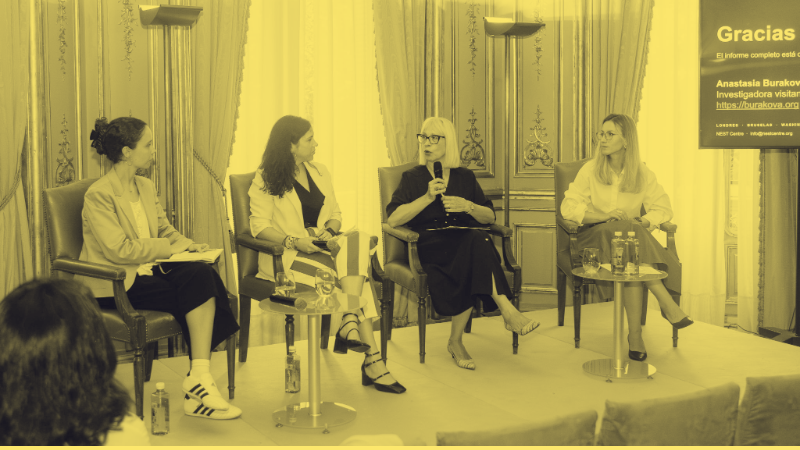
These are some of the conclusions of the report Russian Disinformation Landscape in Latin America: Narratives, actors, techniques and case studies. Brazil, Mexico and Venezuela coordinated by Fundación Maldita.es, with the support of the New Eurasian Strategies Centre, in collaboration with Cazadores de Fake News (Venezuela), Verificado.m (Mexico), and data journalist Daniel Bramatti (Brazil). You can read the full report here.
Venezuela, Russia’s main regional partner
According to research published by different Venezuelans organisations, among them, fact-checkers such as Cazadores de Fake News or EsPaja, Venezuelan state media went from publishing fewer than 50 articles per month referencing RT and Sputnik in 2019 to more than 500 in March 2022. Cooperation was also institutionalized through agreements between Caracas and Moscow, including a memorandum between Venezuela’s Ministry of Communication and Information and Sputnik in 2024.
However, according to data compiled in the Fundación Maldita.es report, the Venezuelan ecosystem underwent a change after January 3, 2026, following the capture of Nicolás Maduro, when there was a decline in pro-Kremlin content published by state actors, the deletion of certain content posted on social media, and a shift toward lower-profile government communication regarding Russia.
Nevertheless, cooperation between the two countries continues, as seen on September 22, 2026, at an event addressing disinformation and fact-checking organized by Venezuela’s International University of Communications. The event was attended, among others, by Russia’s ambassador to the country, Sergey Mélik-Bagdasárov, and was later promoted on the social media accounts of the Russian Embassy in Venezuela.
Mexico: the Club de Periodistas de México and the Agencia Católica de Noticias
In Mexico, the model for disseminating disinformation content and pro-Kremlin narratives is different. The objective appears to be less focused on generating an openly pro-Moscow position than on preserving Mexican neutrality regarding the war in Ukraine.
The role of the Club de Periodistas de México and its publication Voces del Periodista stands out. Seventy-two percent of its content consists of republications from Russian state media, and 53% comes mainly from RT and Sputnik.
Another noteworthy actor is the Agencia Católica de Noticias. As revealed by previous research by Maldita.es and Verificado.mx, the agency, founded in 2019, regularly republishes disinformation campaigns originating on Russian websites such as Argumenty i Fakty or RIA Novosti. It shares with the Kremlin an agenda opposing reproductive and LGBTIQ+ rights; on these issues it also disseminates content, some of it disinformation, together with a network of websites. It also focuses on Spain, with collaborators such as the campaign editor for CitizenGo and AcTÚa Familia, a “pro-life, pro-family and pro-freedom civic platform” based on the principles of Christian humanism.
The strategy in Mexico also includes content aimed at specific audiences. Some narratives link the war in Ukraine to insecurity and organized crime in the country, while others present Russia as a counterweight to U.S. influence. On platforms such as TikTok, the message is adapted to younger audiences through more visual and sensationalist content.
Brazil: the Ukraine and organized crime narrative
Pro-Kremlin influence in Brazil is largely articulated through local organizations and figures, while RT and Sputnik have a more limited direct audience. One of the main narratives links the war in Ukraine to Brazilian criminality. Claims circulate on social media alleging that weapons intended for Ukraine end up in the hands of criminal organizations such as Comando Vermelho or Primeiro Comando da Capital.
Other messages target left-wing sectors through discourse on multipolarity, the BRICS, and reducing dependence on the dollar, while certain organizations and actors exploit issues related to traditional values and cultural policies to connect with conservative audiences.
Telegram as a distribution hub
Although the platforms used vary by country, Telegram is the main distribution hub identified in the analysis. According to the data collected, around 70% of the observed content was distributed through Telegram. Content may begin in Russian state media, then move to local accounts, and ultimately circulate on X, Facebook, WhatsApp, or TikTok. This structure allows messages originating in Kremlin-linked media to later appear as the opinions of local journalists, influencers, or analysts. As a result, the original source of the content may be less evident to the public.
Researchers identified 43 actors within the ecosystem studied. Of these, 23 (53%) act mainly as amplifiers of content produced by third parties, while another 10 are primarily producers of original messages and the remaining 10 perform both functions.
Actors linked to the GFCN
Some actors identified in the region as producers of pro-Kremlin disinformation hold “expert” credentials in the Global Fact-Checking Network (GFCN), an alliance that describes its members as “fact-checkers,” launched in 2025 by the Russian state agency TASS and ANO Dialog, a “non-profit” organization founded in 2019 by Moscow’s Department of Information Technology and sanctioned by the EU. At Maldita.es, we have previously reported that some of these so-called “experts” had shared and disseminated Russian disinformation campaigns and Kremlin-aligned narratives.
It is worth noting that 13 of these GFCN “experts” currently come from Latin American countries. The network reflects a deliberate strategy to bring together and connect influential local figures from different regions under a common narrative framework and organizational structure, enabling them to amplify Kremlin-friendly narratives in their respective contexts. This initiative also supports the network’s continued expansion, reinforcing its regional influence and encouraging the constant exchange of content and interaction.
Beyond social media
In Mexico, RT ran a physical advertising campaign in Mexico City and other cities in 2024 (and repeated it with advertising on taxis in 2026), using billboards, stations, and bus stops. It also organized in-person workshops for journalists. In Venezuela, researchers documented meetings between representatives of Sputnik, TASS, and ANO Dialog and actors linked to the government communications apparatus.
These activities seek more than simply increasing audience reach: they aim to build legitimacy in journalistic, academic, and institutional spheres and subsequently facilitate the circulation of specific messages and narratives.
The objective: reinforce divisions rather than persuade
These campaigns do not appear to be primarily aimed at turning citizens who do not sympathize with Russia into Kremlin supporters. Their strategy seems instead to exploit existing divisions and harden positions.
Of the 240 pieces of content observed and analyzed, 94 (39%) were classified within the category of actions intended to undermine or polarize, with the most significant effect being the reinforcement of pre-existing divisions around the United States, the war in Ukraine, national identity, security, and cultural values.
In this sense, the war in Ukraine functions as a common axis. Narratives include claims about Volodymyr Zelenskyy’s alleged corruption, the alleged diversion of Western aid, the presence of Latin American mercenaries, NATO expansion, or the idea that Ukraine is a state controlled by Nazi forces. The purpose of this narrative is to encourage different Latin American audiences to perceive the conflict as a confrontation in which responsibility is shared and to remain neutral.
You can read the full report here. In parallel, the Nest Centre has produced a complementary report, based on the research and data collected by Maldita.es, which you can read at this link.
Methodology
The research uses a mixed-methods approach combining quantitative analysis of a database created from social-media monitoring with qualitative semi-structured interviews conducted with fact-checkers from each of the three countries studied. Data collection was carried out by Cazadores de Fake News (Venezuela), Verificado (Mexico), and data journalist Daniel Bramatti (Brazil), under the coordination of Maldita.es.
The analysis follows James Pamment’s ABCDE framework (2020), which structures the research around five dimensions: Actors, Behavior (TTP), Content, Distribution, and Effect. Tactics are coded according to the DISARM Red framework, while the actor typology follows the EEAS classification (official state channel, state-controlled media outlet, state-linked channel, and state-aligned channel).
The database is structured in two sheets: ACTORS (43 records including type, platform, metrics, and confidence level in the attribution) and OBSERVABLE ELEMENTS (240 content records including original and archived URLs, claim, narrative, TTP, and distribution metrics).