
The global final will be held in Lisbon, during the GEN Summit 2018, between 30 May and 1 June 2018.
The Spanish competition was held at the headquarters of El Confidencial (thanks, colleagues), organised together with the Global Editors Network (GEN) and with the support of Google News Lab. Eleven media outlets took part, developing over two days (very good) tools to improve and innovate breaking news coverage:
- Diari Ara, with Ara Stories.
- Cadena Ser, with Alert.
- Media.cat with its Thermometer on Censorship.
- MediaLab-Prado with Linked Data-Driven Context.
- CCMA with Verificador Ciudadano
- Videona with its News Noise Reducer.
- Nació Digital and its Timelined chat for breaking news coverages.
- Vocento with El Correo Zoom.
- El Confidencial with Funnel
- Diario de Navarra with Hospital de Campaña para la información.
- And finally, Maldita.es / laSexta with Breaking Hoaxes.
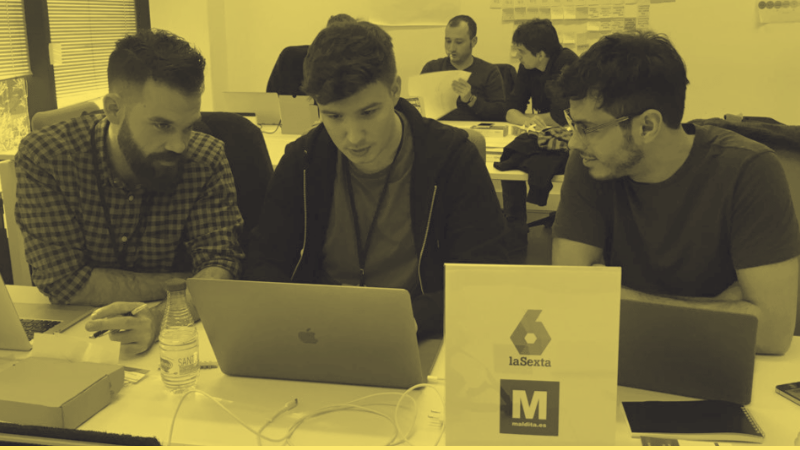
From the team made up of members of Maldita.es and laSexta, data journalist Nacho Calle, developer David Fernández and designer Alberto Reverón took part. We would like to congratulate Diari Ara and El Confidencial, who were awarded a special mention by the jury, as well as the rest of the participants for the high level of all the projects. We would also like to thank the Jury for having valued our project in this way and for their involvement and help in shaping it, with special thanks to Ana Ormaechea and Eva Morell for their clarity and guidance.
What is the ‘Breaking Hoaxes’ project that we presented?
A web application that allows searches in official sources and reliable sources in the latest debunks. It is aimed at newsrooms, with a structure divided into blocks and filters. On the one hand, social media accounts are aggregated —such as, for example, the Twitter accounts of official sources—. In addition, it is possible to add websites so that the system performs scraping on them, obtaining press releases and information published on institutional websites or other media in real time and as the event unfolds. The newsroom can contribute reliable sources that it has confirmed through experience or through an editorial commitment with the outlet. The web application is updated at the same time with the debunks that the maldita.es team carries out during the event. The user will receive desktop notifications every time a debunk is included. The reporter will have reliable information and will be able to cross-check the breaking data they receive. In the newsroom, journalists will be able to contrast and verify the latest data. On the ground, journalists will have access to a large amount of information, with the possibility of filtering it by origin and performing searches to confirm data in seconds. It is a very lightweight application, with communications exclusively based on text, so it works even at times when coverage is low due to terminal saturation or location. It is a web application built with open-source software, based on the PHP Symfony framework. The end-user dashboard is a single page in which all information is handled via JavaScript, without the page reloading. In this way, the user does not lose the state of the page they were on (scroll, open information, etc.) when performing other actions. For information scraping, any script that can connect to a MySQL database can be used. For this example we used Python scripts, although for the prototype we preloaded information into the database and supplied it on demand. Finally, the debunked information comes from the API that Maldita.es / MalditoBulo already has available. Likewise, the information sent for verification to the Maldita team would connect to an endpoint of that same API. The headline has been explained better to clarify that it was a team that had members from both projects. Maldita.es does not belong to nor has it ever belonged to laSexta.